Declining Snowpack in Rockies Cools CO2, Slows Gas Release from Winter Forest Soils
A decrease in Rocky Mountain snowfall has slowed the release of heat-trapping carbon dioxide gas from forest soils into the atmosphere during the dead of winter, according to results of a new study.
Scientist Russell Monson of the University of Colorado at Boulder and his colleagues found that lack of snow has decreased the winter insulation of soils, cooling the soils and slowing the metabolism of soil microbes. Snow acts as an insulator, and without it, soil temperatures and microbial metabolism cool down, said Monson.
The deeper the snow pack, "the more CO2 we once observed leaving the forest," Monson said. "This forced us to look at the winter period more closely than before." The scientists found that the reverse was also true: little snow pack, less CO2 released. Microbes usually release large amounts of CO2 into the atmosphere, but are no longer doing so.
But the discovery of what Monson called a "serendipitous effect" of reduced snowfall--slowing the amount of greenhouse gas released into the atmosphere--does little to bolster the overall environmental health picture of the West's mountain forests in recent years.
"This is a small amount of good news in a large cloud of bad news," said Monson, lead author of a paper that appears in this week's issue of the journal Nature. "While winter CO2 emissions from forest soils have slowed, the lack of winter moisture is stressing the trees during the spring and summer and inhibiting the absorption of much larger amounts of CO2 during their growing season."
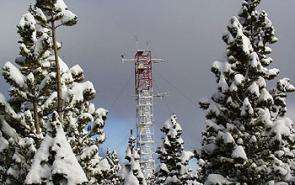
The study was conducted at the National Science Foundation (NSF)'s Niwot Ridge Long-Term Ecological Research (LTER) site west of Boulder. The site is one of 26 such sites, and is home to one of several dozen AmeriFlux installations, which measure CO2 activity. Niwot Ridge has five towers studded with these climate instruments.
The researchers used the 100-foot-high towers--placed at an altitude of 10,000 feet in a forest of lodge pole pine, sub-alpine fir and Englemann spruce--to measure CO2 , water, and energy exchanges between the biosphere and atmosphere. They used the instruments to zero in on swirling winds drifting over the rugged terrain, and took millions of individual CO2 readings from 1998 to 2004.
"Measurement of CO2 in mountain forests like those at Niwot Ridge is critical to understanding the bigger environmental picture," said Henry Gholz, director of NSF's LTER program. "To really understand how forests, soil microbes and the atmosphere interact, we need information from monitoring systems like this one."
Recent studies have shown that some mountain ranges in Europe and in the Western United States, including parts of the Rocky Mountains and the Sierra Nevada, have experienced decreases of 50 to 75 percent in amount of snowfall in recent decades. The declining snow pack trend correlates with rising temperatures, said Monson.
During several recent winters, decreased snow pack has left trees without moisture for extended periods during spring. "Trees have not had the snow melt moisture that usually tides them over until the summer rains begin in late July and August," said Monson.
The environmental stress from lack of moisture inhibits the ability of trees to take up CO2 in the summer, and makes them more susceptible to threats like insect infestations, diseases and forest fires, the researchers found.
Co-authors of the paper include David Lipson of San Diego State University, Sean Burns, Mark Williams and Steven Schmidt of CU-Boulder, and Andrew Turnipseed and Anthony Delany of the National Center for Atmospheric Research.
Source: NSF


