The Inexhaustible Energy Source Beneath Our Feet
May 24, 2004
Siemens Power Systems

According to the expert Willy Gehrer, the environmentally friendly generation of electricity from geothermal sources is going to play an important role in the future of energy production. “I’m convinced that in 20 years geothermal power plants will be delivering ten percent of the total electricity produced worldwide,” Gehrer told Pictures of the Future, the Siemens research magazine. Gehrer is President of ETG Electrosuisse (Swiss Electrotechnical Association) and is the head of Power Systems at Siemens Switzerland.

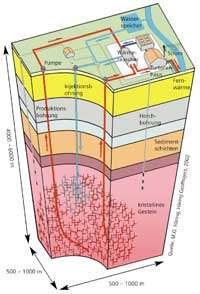
Gehrer favors the hot dry rock process. In contrast to methods that use only hot springs in volcanically active regions as energy sources, this new process makes it possible to generate electricity anywhere in the world. With this process, water is pumped into strata of crystalline rock that lie four to six kilometers deep in the earth and have a temperature of about 200 degrees Celsius. Production wells tap the heated, pressurized water and transport it to a heat exchanger on the surface. Finally, the heat exchanger drives a steam turbine with a generator for electricity production. After it has cooled, the water is pumped back into the earth.
“The first commercial power plant of this kind is due to go into operation in five years in Basel, Switzerland. It will deliver 30 megawatts of thermal energy and three megawatts of electrical power,” Gehrer says. “That’s enough to supply 5,000 households.” The cost of producing the electricity is competitive with other renewable energy sources, he adds. At 0.12 euros per kilowatt-hour for electricity and 0.02 euros for heating, the costs correspond to those of a new hydroelectric or wind-driven power plant.
Gehrer believes that geothermal energy is the energy source of the future. In addition to producing no emissions, he explains, it’s virtually inexhaustible and is available around the clock all over the world. The use of geothermal energy is more a question of will than of technical feasibility. “We know very well that we’re complacently sitting on a virtually inexhaustible supply of geothermal energy and choosing instead to transport oil, gas and coal over thousands of kilometers rather than digging a few kilometers into the earth,” Gehrer says.

The original release can be found on Siemens web-site.

Explore further: Kenneth Wilson, Nobel winner for physics, dies

add to favorites email to friend print save as pdf

Related Stories

Poland may delay launch of nuclear plants

23 minutes ago

Poland could delay building its first nuclear power plants as natural gas, including shale gas, becomes less costly, the prime minister of the central European heavyweight said Tuesday.

US spy chief: Plot against Wall Street foiled

13 minutes ago

The U.S. foiled a plot to bomb the New York Stock Exchange because of the sweeping surveillance programs at the heart of a debate over national security and personal privacy, officials said Tuesday at a rare ...

The hidden agenda of Obama's opposition

1 hour ago

Is the US Tea Party movement a racial backlash against President Obama? A new study by Angie Maxwell from the University of Arkansas, and Wayne Parent from Louisiana State University, assesses whether racial attitudes are ...

Recommended for you

RHIC's perfect liquid a study in perfection

18 hours ago

(Phys.org) —When heavy ions (the nuclei of heavy atoms such as gold and lead) collide at high energies at Brookhaven National Laboratory's Relativistic Heavy Ion Collider (RHIC) and Europe's Large Hadron Coll ...

User comments : 0

More news stories

Origins of 'The Hoff' crab revealed (w/ Video)

The history of a new type of crab, nicknamed 'The Hoff' because of its hairy chest, which lives around hydrothermal vents deep beneath the Southern Ocean and Indian Ocean, has been revealed for the first ...

3D printing tiny batteries

(Phys.org) —3D printing can now be used to print lithium-ion microbatteries the size of a grain of sand. The printed microbatteries could supply electricity to tiny devices in fields from medicine to communications, ...