When is a worm not a worm? When it’s a jellyfish...
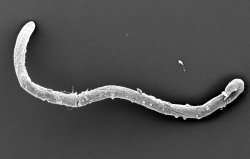
One of the world’s strangest creatures has found its long-lost kin. Oxford University scientists have discovered that an extremely rare gutless worm is related to sea anemones and jellyfish, rather than similar-looking animals, reports this week’s Science. The finding could cause an evolutionary rethink.
The worm, Buddenbrockia, has been seen only a handful of times since its discovery in 1851 and exactly where it fits in the animal kingdom has long puzzled scientists. ‘It has no mouth, no gut, no brain and no nerve cord,’ said Professor Peter Holland of Oxford University’s Department of Zoology who led the study. ‘It doesn’t have a left or right side or a top or bottom – we can’t even tell which end is the front!’
Its bizarre body-plan is quite unlike other worms, such as nematodes, that despite their simplicity have different ‘organs’ on different sides – and at different ends – of their bodies in the same way that fish and mammals do. Professor Holland said: ‘Buddenbrockia is very unusual in not displaying this kind of body asymmetry. Seen in cross section it is completely symmetrical so no way is ‘up’ and no direction is ‘forward’.
To find out what in the animal kingdom the worm is related to, Professor Holland, Dr Eva Jimenez and colleagues analysed 50 genes from Buddenbrockia and compared them to the genes of other animals. They found that despite its worm-like body shape Buddenbrockia is actually related to animals it looks nothing like, such as sea anemones and jellyfish. ‘This means that the worm-like body shape evolved at least twice from two completely different kinds of animal,’ said Professor Holland. ‘It is one of the most striking examples of convergent evolution you will ever see – we are not talking about the convergent evolution of individual organs or body parts, such as eyes or wings, but of the whole body shape.’
The new study is also good news for salmon farmers as it may help them to tackle a devastating parasite. Buddenbrockia is closely related to the parasite Tetracapsula bryosalmonae that infects the kidneys and spleens of salmon causing immune cells to multiply out of control destroying these organs and killing the fish. Parasites such as Tetracapsula bryosalmonae are notoriously hard to study because of the difficulty of separating the parasite’s DNA from the host’s DNA. But because Buddenbrockia sometimes swims free from its host (a moss animal or bryozoan) its DNA can be isolated and analysed: opening up a genetic window onto the mysterious world of such parasites.
Professor Peter Holland said: ‘This sort of genetic detective work has only become possible in the wake of the Human Genome Project, which has helped to drive down the costs of large-scale DNA sequencing. In the future these techniques could shed fresh light on the relationships between many other animals that, up until now, have been grouped together according to what they looked like rather than what genetic information they share.’
Source: University of Oxford


