Critical protein prevents DNA damage from persisting through generations
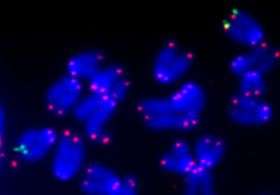
A protein long known to be involved in protecting a cell from genetic damage has been found to play an even more important role in protecting the cell’s offspring. New research shows that the protein, known as ATM, is not only vital for helping repair double-stranded breaks in the DNA of immune cells, but is also part of a system that prevents genetic damage from being passed on when the cells divide.
Early in the life of B lymphocytes — the immune cells responsible for hunting down foreign invaders and labeling them for destruction — they rearrange their DNA to create various surface receptors that can accurately identify different intruders, a process called V(D)J recombination. Now, in a study published online in the journal Cell, Rockefeller University professor Michel Nussenzweig, in collaboration with his brother Andre Nussenzweig at the National Cancer Institute and their colleagues, shows that when the ATM protein is absent, chromosomal breaks created during V(D)J recombination go unrepaired, and checkpoints that normally prevent the damaged cell from replicating are lost.
Normal lymphocytes contain a number of restorative proteins, whose job it is to identify chromosomal damage and repair it or, if the damage is irreparable, prevent the cell from multiplying. Earlier research by Andre and Michel Nussenzweig had identified other DNA repair proteins that are important during different phases of a B lymphocyte’s life. It was during one of these studies, which examined genetic damage late in the life of a B cell, that they came across chromosomal breaks that could not be explained.
So the researchers began to look into the potential role of V(D)J recombination. “We were not expecting it to be responsible for the breaks we were seeing,” says Michel, Sherman Fairchild Professor and head of the Laboratory of Molecular Immunology. “Because for it to be responsible, the breaks would have had to happen early on; the cell would have to divide, mature, maintain the breaks and stay alive with broken chromosomes.” This, in fact, was precisely what they found.
The ATM protein appears to have two roles in a B cell: It helps repair the DNA double-strand breaks, and it activates the cell-cycle checkpoint that prevents genetically damaged cells from dividing. “ATM is required for a B cell to know that it has a broken chromosome. And if it doesn’t know that it seems to be able to keep on going,” says Michel, who’s also a Howard Hughes Medical Institute investigator.
Since the ATM protein is mutated in a number of lymphomas — cancers of the lymph and immune system — the new finding suggests to researchers that the lymphocytes could have been living with DNA damage for a long time, and that this damage likely plays a role in later chromosomal translocations, rearrangements of genetic materials that can lead to cancer.
Michel and his brother, who’ve been collaborators for more than a decade, intend to pursue the molecular mechanisms by which these chromosomal translocations occur. “I think it’s important to understand them,” he says, “because eventually we might be able to prevent these dangerous chromosome fusions.”
Citation: Cell: June 28, 2007
Source: Rockefeller University


