Crammed with charged DNA, pressure rises inside virus
Jun 05, 2007
Crammed with charged DNA, pressure rises inside virus
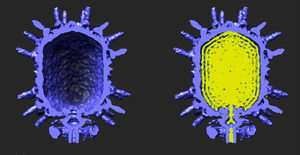
Image credit: Ye Xiang and Michael Rossmann, Purdue University.

It could be an artist’s depiction of someone’s stomach before and after a rather decadent meal. But it is a 3-D cryoelectron microscope reconstruction of the cross-section of a virus, before and after cramming itself full of its own DNA.

The virus, phi29, has a tiny motor that pumps its DNA into the capsid—outer shell—during the assembly process. The potential energy of the tightly coiled DNA may help phi29 inject its genetic material into the bacterial cells it infects.

Now a team led by physicists at the University of California, San Diego has used laser tweezers to measure the forces exerted by the motor as it pushes the DNA into the capsid.

“The virus’ motor has to do mechanical work to overcome two factors that create resistance,” said Douglas Smith, an assistant professor of physics at UCSD who headed the team that published the discovery this week in the early on-line edition of Proceedings of the National Academy of Sciences. “First, the DNA must be forced to bend. Second, the electrostatic repulsion of the DNA’s negatively charged backbone must be overcome. We found that the positively charged ions in the solution are critical to overcoming this repulsion. Without the right combination of positively charged ions, the virus could not force all of its DNA into the capsid.”

The researchers discovered that the forces in the capsid are slightly higher than predicted by theoretical calculations. They say this may be because the packed DNA is less ordered than assumed in the calculations.

Source: University of California - San Diego

Explore further: Navy dolphins discover rare old torpedo off Calif. coast near Coronado

add to favorites email to friend print save as pdf

Related Stories

New nucleotide could revolutionize epigenetics

Apr 16, 2009

Anyone who studied a little genetics in high school has heard of adenine, thymine, guanine and cytosine - the A,T,G and C that make up the DNA code. But those are not the whole story. The rise of epigenetics in the past decade ...

Viruses, start your engines!

Dec 29, 2008

(PhysOrg.com) -- Peering at structures only atoms across, researchers have identified the clockwork that drives a powerful virus nanomotor. Because of the motor's strength--to scale, twice that of an automobile--the ...

Recommended for you

EU bans three pesticides harmful to bees

12 hours ago

The European Commission said Friday that it will ban for two years beginning in December pesticides blamed for killing the bees that pollinate food and fruit crops.

Studying the Noble King Mackerel

12 hours ago

They are sometimes called "smokers," due to the speed at which a fishing line zips out the reel and "smokes" after they hit on the bait.

User comments : 0

More news stories

EU bans three pesticides harmful to bees

The European Commission said Friday that it will ban for two years beginning in December pesticides blamed for killing the bees that pollinate food and fruit crops.

Galaxies fed by funnels of fuel

(Phys.org) —Computer simulations of galaxies growing over billions of years have revealed a likely scenario for how they feed: a cosmic version of swirly straws.

Google eyes emerging markets networks

Google has become deeply involved in a series of projects to build and operate wireless networks in emerging markets including sub-Saharan Africa and Southeast Asia, a report said Friday.