Model unscrambles complex crystallization puzzle
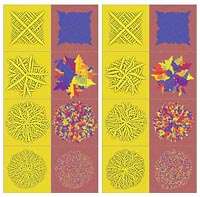
The patterns that form as plastics, metals and many other materials crystallize can vary incredibly, ranging from sea-urchin-like spheres to elaborate tree-like branches. Now, Hungarian and National Institute of Standards and Technology scientists report in the September issue of Nature Materials* that they have developed a way to predict the polycrystalline microstructures that will form as complex liquid mixtures cool and solidify.
Ultimately, the team's new simulation tool could help manufacturers of everything from plastic bags to airplane wings to design new products with improved strength, durability and other properties.
Image: Four sets of simulated images show the striking similarities between crystals "grown" under different conditions. The first two columns on the left show crystals grown with increasing amounts of impurities. The top row crystal has no "dirt," it has a symmetric crystal pattern (yellow image) and it has no "grains"— all the molecules are aligned in the same direction (blue image.) As greater amounts of impurities are added, the crystal grows more and more randomly.
The two columns on the right show crystals grown with increasing differences between the speed the crystal naturally wants to grow and the speed that liquid molecules can rotate into alignment with the growing crystal or be forced to solidify into a new grain. This type of difference happens in the real world when liquid alloys or polymers are supercooled substantially below the temperature that they would naturally solidify. The low temperature tends to speed up the crystallization process but the increasing viscosity of the liquid makes it harder for molecules to move into aligned grains, so the crystal grows more randomly.
Images generated with the team's mathematical model match up almost feature for feature with the seemingly random crystal patterns formed in experiments as temperatures or other processing variables are modified. The model accurately predicts how both impurities (or additives) and process differences affect the sizes, shapes and orientations of crystals that form during the so-called supercooling process.
Whether initiated by "dirt" or by processing conditions, the resulting patterns can be strikingly similar. This "duality in the growth process," notes NIST's James Warren, may help explain why polycrystalline growth patterns are so prevalent in polymers and other materials derived from complex mixtures.
Findings based on the model indicate that instabilities along the boundary between liquid and solid areas during solidification effectively clash with the otherwise orderly process of crystallization. Tiny crystals-in-the-making move and position themselves along the growth front, assuming an orientation peculiar to the energy conditions at their location. Varying local conditions produce crystals in seemingly disordered arrays, accounting for the rich diversity of microstructural patterns.
Laszlo Granasy, of Hungary's Research Institute for Solid State Physics and Optics, led the research effort. *L. Gránásy, T. Pusztai, T. Börzsönyi, J.A. Warren, and J.F. Douglas. A general mechanism of polycrystalline growth. 2004. Nature Materials advance on-line publication, Aug. 8, 2004.
Source: NIST


