One man's video game is another's exercise regime
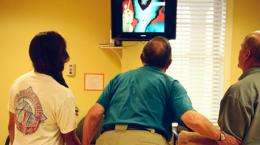
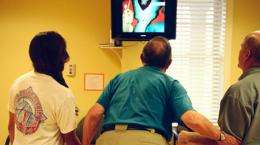
Dr. Umit Ergin is cramming for a final exam. Standing on a balance board created by Nintendo for its Wii Fit series, Dr. Ergin -- a retired octogenarian internist who good-naturedly prefers to call himself "mid-mature" -- is participating in a variety of exercises displayed on a nearby television. All the while he is under the watchful eye of Associate Professor of Kinesiology and Health Sciences Ray McCoy and student assistant Laura Halley ’11.
It is the last session of six weeks of training, three times a week, 20 minutes a session, held at the retirement community where he and his wife moved two years ago. The next day, Dr. Ergin will return to a testing center inside William & Mary’s Adair Hall, where six weeks earlier he was evaluated for balance and functional movement. Those tests will be re-administered, and a comparison of the two sets of results made.
“Wii Fit claimed to improve balance,” explained McCoy. “In our study, we wanted to see if that was true. Could you, by moving your center of balance in compliance with the game, help train brain-to-muscle coordination to hopefully improve balance?”
A controlled study
McCoy isn’t the first professor to engage a study using Wii Fit, but he says the controls he has imposed make his project different. For example, participants trained on Wii Fit only in McCoy’s presence.
“Some people said, ‘Go home and use the Wii and come back,’” McCoy explained. “You never know how much they use it. We’ve controlled things a lot better.”
Dr. Ergin is the eighth participant in McCoy’s study. During the fall, 2010 semester, the professor planned to train and test his final two subjects then release his conclusions.
“I like practical research projects, and this fits right into that,” McCoy said. “We can see where it really benefits people now. A lot of basic research is very necessary, but doesn’t have application right away. This is obviously very applicable to anybody who has balance concerns.”
Studies show that, on average, 35 to 40 percent of people 65 and older fall at least once a year. Some data indicates that those who sustain broken hips have a 20 percent chance of not surviving another year, and a 20 percent chance of never regaining their mobility.
By comparison, Dr. Ergin has been lucky. He fell about nine years ago and broke his pelvis. He fell again about four years ago and ruptured his right quadriceps. He recovered from each, but as he and his wife once enjoyed long, romantic evenings on the dance floor, he recently began grasping his wife’s arm for security when walking outside.
“I had tremendous anxiety,” he admits. “It was a terrible way to feel.”
When he saw McCoy’s advertisement seeking volunteers, he was immediately interested.
“I have this problem,” he said. “I wanted to increase my balance. I was very much motivated. If you are very much motivated, this is a wonderful situation, very helpful.”
Beginning with balance
McCoy starts out with Wii games that focus on passive balance. Dr. Ergin stands on the Wii board and tries to keep the red dot on the screen—his center of balance—inside a yellow circle. Then he repeats it after bringing his hands together over his head. Then he alternates putting one foot on top of the other and lifting one arm. That stretches the spine and strengthens leg muscles.
After a short break, some of the more animated games begin.
Just MoveOne minute, Dr. Ergin is asked to pretend he is encased in a bubble that is hovering over a narrow creek with tree limbs protruding out. The object is to use subtle body movements to steer the bubble down the serpentine creek without running off-course and bursting. It tests circular balance.
Then he’s a penguin perched on a bobbing table of ice, twisting himself gently to “catch” fish that are jumping out of the water. The exercise also works on circular balance.
He maneuvers marbles through holes while pretending to stand on a floating tabletop, and rumbles through a downhill skiing course, knocking down fewer gates with each attempt. The latter focuses on shifting from right to left and vice-versa.
“I’m doing so well,” he jokes, “maybe I should go skiing.”
Encouragement helps
In addition to flanking him in case he falls, McCoy and Halley offer Dr. Ergin encouragement throughout the exercises. At one point, McCoy moves in rhythm with the doctor.
“Up, back, on your toes,” he instructs gently. “Now back up, get a running start.”
When Dr. Ergin advances to his highest level ever on one of the games, he exchanges a broad smile and a quick hug with Halley.
“It’s a good package,” he said. “First of all, there’s the camaraderie here. There’s emotional involvement here, which we all need. To hear young people giving you encouragement—“You can do it!”—is a wonderful thing. We’ve become so close that I’d accept this girl as my granddaughter.”
The next day at Adair Hall, the final exam is videotaped.
It begins with Dr. Ergin standing on a low platform staring at a dot on a blackboard, continues with him moving from a sitting position to standing, ideally without having to use his arms to rise (he doesn’t). Then he pivots out of one chair and into another, and stands with his eyes closed for 10 seconds.
Next he stands with his feet together, which he does without help. That exercise is followed by having him make a complete turn in one direction then the other. Then comes the forward reach, in which he puts his hands together and leans forward as far as he can towards a blue piece of tape stuck to a wall.
He’s asked to pick an object up off the floor—no problem—turn to look over each shoulder, alternate his feet to tap eight times quickly and, finally, to stand on one foot.
After a short break, McCoy and an assistant place pieces of black tape on Dr. Ergin’s joints and strategic places on his white shoes to facilitate taping his gait tests. Among the measurements taken are for step length, symmetry, continuity and path.
The study continues
There seems little doubt that the doctor has improved in many areas; how much he has improved wouldn’t be revealed until the complete study was finished. McCoy said he plans to offer the results to the Journal of Physical Therapy.
“Physical therapists are starting to use these games in their rehab work,” he said. “So we’ll give them some validation that, yes, these do work. Or, be careful, maybe they don’t.”
Dr. Ergin didn’t need test results to be convinced.
“I recommend everything about this,” he said. “I am more confident now in the way I am walking. Most important, my anxiety has all but disappeared. I have more confidence in myself. And the proof of that is in the way that I walk, from the short steps that I used to take to the longer steps I take now.”


