Focusing on one cell
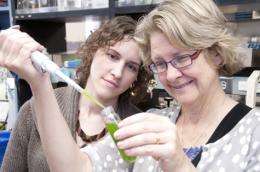
Most people don’t think highly of pond scum, but for Susan Dutcher, PhD, the single-celled green algae Chlamydomonas are incredible creatures worthy of her life’s work.
Dutcher, professor of genetics and of cell biology and physiology, studies Chlamy, as the organism is lovingly called by those who work with it, as a model for understanding how errors in genes for human cilia — the hair-like extensions that grow on almost every cell in the body — lead to a litany of health problems in people.
Algae sport long, thin tails called flagella, which are remarkably similar to cilia in humans, where they act like antennas to process signals essential for development and survival or beat in rhythmic fashion to remove potentially harmful pathogens.
“The similarity between the Chlamy flagella and human cilia is striking,” says Dutcher, an internationally known expert in her field. “Their structure and function is extraordinarily conserved throughout the scope of evolution.”
In the body, cilia that are active early in development ensure that organs like the heart and stomach end up in the right place. Cilia also clear away dirt and microorganisms from the lungs, sinuses and ears, help sperm swim and keep fluid flowing into and out of the brain.
Thus, it’s no surprise, Dutcher says, that defects in cilia and basal bodies, which anchor cilia to a cell, can cause major health problems, including polycystic kidney disease and genetic disorders that affect the ear, nose and sperm, placement of internal organs, number of fingers and toes and length of limb bones.
Dutcher’s pioneering studies have identified numerous genes needed to construct flagella and basal bodies in Chlamydomonas and their counterparts in humans.
In an innovative collaboration funded by the Children’s Discovery Institute, Dutcher works with Thomas Ferkol, MD, professor of pediatrics, and Philip Bayly, PhD, the Lilyan and E. Lisle Hughes Professor of Mechanical Engineering, to home in on genetic defects in cilia that cause primary ciliary dyskinesia, a rare hereditary disease. Children with the disorder suffer from recurrent lung, sinus and ear infections because their cilia can’t clear away bacteria-laden mucus. Their internal organs may be on the wrong side, and adult males usually are infertile.
Ferkol treats a large, extended family in Missouri with the disease.
“We are inserting mutations into Chlamy that are identical to those in this family,” Dutcher says. “Then, we can look to see how they affect the beat stroke of the flagella. Later, we’ll use Chlamy to screen potential drugs against the disease.”
The researchers also are investigating whether less severe defects in cilia may underlie chronic ear infections in children.
“Our project wouldn’t be possible without Susan’s expertise,” Ferkol says. “She has remarkable insights to Chlamydomonas genetics, and her understanding of the structure and function of their flagella can be translated to human ciliary defects. We share the same excitement that our work has the potential to improve the diagnosis and treatment of patients with these diseases.”
Falling for genetics
Genetics is a field that Dutcher fell into, literally.
In high school, Dutcher developed a fondness for genetics, which combined her interests in both biology and math. But in college, she was drawn to environmental ecology.
Dutcher attended Colorado College, which offers a unique educational experience: Students take only one class at a time.
Environmental ecology was a popular major because it involved adventurous field trips. In her junior year, as part of an ornithology course, Dutcher had signed up for a weeklong excursion to the Gulf Coast to watch migratory birds with her classmates. Before the trip, she dutifully completed a term paper on the evolution of bird beaks and, hurrying back to her dorm late at night after a full day in the library, Dutcher tripped, fell and broke her foot.
She ended up in a cast and out of the ornithology class.
“I couldn’t go on the field trip,” Dutcher says, “and the only course still open was genetics.”
But in just a few weeks’ time, Dutcher’s aspirations had completely changed.
“I quickly realized that genetics was all I wanted to do,” she says.
Dutcher earned a doctorate in genetics in 1980 from the University of Washington in Seattle, which was well-known at the time as a powerhouse for yeast genetics.
Nobel Laureate Lee Hartwell, PhD, was Dutcher’s thesis adviser. He shared the Nobel Prize in Physiology or Medicine in 2001 for his discovery of key genes in yeast that control, even in higher organisms, how a cell grows and divides to replicate itself.
“Lee is an amazing person,” Dutcher says. “He served as a real role model for me in that he worked in the lab. His time at the bench was from 9 a.m. to noon. He didn’t answer his phone or do anything else. That’s incredibly unusual.”
Dutcher appreciated the one-on-one time Hartwell gave to his students, usually over a cup of coffee, to discuss research results and new ideas.
“It was very much a give-and-take atmosphere,” she says. “You didn’t feel like he was the big boss and you were the underling.”
Dutcher brings a similar openness and work ethic to her own lab. She regularly works at the bench and is easily accessible.
“She’s one of the smartest people I know,” says Alison Albee, PhD, a postdoctoral research scholar in the Dutcher lab. “Susan’s encouraging and always in tune with what’s going on in the lab. She’s also a wonderful role model for women like me who want to pursue careers in science. She goes out of her way to help students and makes you realize that you really can do it.”
Falling for Chlamy
Dutcher completed her postdoctoral studies at Rockefeller University in New York City. It was there that she made the leap from yeast to Chlamy.
Some of the same cell cycle genes she studied in yeast with Hartwell also play a role in the microtubules that help power flagella and cilia. The microtubule proteins, though present in other model organisms, are more interesting in Chlamy because they look and function so much like those in human cilia.
“I thought I would get to the proteins and then go back to yeast,” Dutcher says. “But then, I fell in love with Chlamy, and, in the long run, it has ended up being really interesting.”
In 1983, Dutcher joined the faculty of the University of Colorado at Boulder. Her husband-to-be, computational biologist Gary Stormo, PhD, the Joseph Erlanger Professor of Genetics at WUSTL, was finishing postdoctoral studies there and later became a faculty member. But a decade later, both were looking for new opportunities to grow in their careers.
That’s when they were lured by Robert Waterston, MD, PhD, then head of Washington University's Department of Genetics, to WUSTL.
“We decided that science beat out the mountains,” Dutcher says. “Although, I must admit, the day we arrived in July of 1999, I wasn’t quite sure. It was 104 degrees.
“But this has been an amazing place for me,” Dutcher adds. “In retrospect, I don’t think I could have accomplished all that I have if I hadn’t been here at Washington University.”


