MIT team takes high-res, 3-D images of eye
Apr 30, 2007
MIT team takes high-res, 3-D images of eye
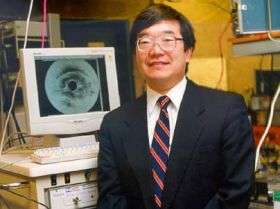
Professor James Fujimoto with a high-resolution, 3-D image generated using a new type of laser in combination with the Optical Coherence Tomography (OCT) system he developed in the early 1990s with Eric Swanson of MIT Lincoln Laboratory. Credit: John Cook, RLE

In work that could improve diagnoses of many eye diseases, MIT researchers have developed a new type of laser for taking high-resolution, 3-D images of the retina, the part of the eye that converts light to electrical signals that travel to the brain.

The research will be presented at the Conference on Lasers and Electro-Optics and the Quantum Electronics and Laser Science Conference in Baltimore on May 10.

The new imaging system is based on Optical Coherence Tomography (OCT), which uses light to obtain high-resolution, cross-sectional images of the eye to visualize subtle changes that occur in retinal disease. OCT was developed in the early 1990s by MIT Professor James Fujimoto, Eric Swanson at MIT Lincoln Laboratory and collaborators; Fujimoto is an author of the report to be presented in May.

"Within the last few years optical coherence tomography has become a standard diagnostic for ophthalmology. New techniques are now enabling dramatic increases in image acquisition speeds. These advances promise to enable new and powerful three-dimensional visualization methods which could improve early diagnosis of disease and treatment monitoring," said Fujimoto, who holds appointments in MIT's Department of Electrical Engineering and Computer Science and the Research Laboratory of Electronics.

Conventional OCT imaging typically yields a series of two-dimensional cross-sectional images of the retina, which can be combined to form a 3-D image of its volume. The system works by scanning light back and forth across the eye, measuring the echo time delay of reflected light along micrometer-scale lines that, row by row, build up high-resolution images.

Commercial OCT systems scan the eye at rates ranging from several hundred to several thousand lines per second. But a typical patient can only keep the eye still for about one second, limiting the amount of three-dimensional data that can be acquired.

Now, using the new laser, researchers in Fujimoto's group report retinal scans at record speeds of up to 236,000 lines per second, a factor of 10 improvement over current OCT technology.

Future clinical studies, as well as further development, may someday enable ophthalmologists to routinely obtain three-dimensional "OCT snapshots" of the eye, containing comprehensive volumetric information about the microstructure of the retina. Such snapshots could potentially improve diagnoses of retinal diseases such as diabetic retinopathy, glaucoma and age-related macular degeneration.

Fujimoto's colleagues on the work are Robert Huber, a visiting scientist at MIT now at the Ludwig-Maximilians University in Germany, Desmond C. Adler and Vivek Srinivasan. Adler and Srinivasan are both graduate students in EECS.

Source: MIT

Explore further: Study reveals new mechanism for estrogen suppression of liver lipid synthesis

add to favorites email to friend print save as pdf

Related Stories

Habit formation fine-tuned by experience

Oct 26, 2010

Most people have habits that guide them through daily life -- for example, their path to work in the morning, or their bedtime routine. The brain patterns that drive this behavior are not well-understood, but a new study ...

Neuroscientists find neural stopwatch in the brain

Oct 19, 2009

(PhysOrg.com) -- Keeping track of time is one of the brain's most important tasks. As the brain processes the flood of sights and sounds it encounters, it must also remember when each event occurred. But how ...

Worm study sheds light on human aging, inherited diseases

Oct 01, 2007

Microscopic worms used for scientific research are living longer despite cellular defects, a discovery that is shedding light on how the human body ages and how doctors could one day limit or reverse genetic mutations that ...

Rapid, high-resolution 3-D images of the retina

May 02, 2007

In efforts that may improve diagnoses of many eye diseases, researchers will introduce a new type of laser for providing high-resolution 3-D images of the retina, the part of the eye that converts light to electrical signals ...

Recommended for you

Scientists discover molecule triggers sensation of itch

May 23, 2013

Scientists at the National Institutes of Health report they have discovered in mouse studies that a small molecule released in the spinal cord triggers a process that is later experienced in the brain as ...

Discarded immune cells induce the relocation of stem cells

May 23, 2013

Spanish researchers have discovered that the daily clearance of neutrophils from the body stimulates the release of hematopoietic stem cells from the bone marrow into the bloodstream, according to a report published today ...

User comments : 0

More news stories

Heart failure accelerates male 'menopause'

Heart failure accelerates the aging process and brings on early andropausal syndrome (AS), according to research presented today at the Heart Failure Congress 2013. AS, also referred to as male 'menopause', was four times ...

Feds fight morning-after pill age ruling in NY

(AP)—Department of Justice lawyers have again asked a federal appeals court in New York to delay lifting age restrictions and prescription requirements on an emergency contraceptive popularly known as the morning-after ...

Galaxies fed by funnels of fuel

(Phys.org) —Computer simulations of galaxies growing over billions of years have revealed a likely scenario for how they feed: a cosmic version of swirly straws.