Asymmetry due to perfect balance
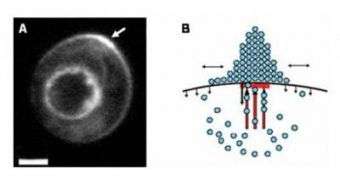
Cell membranes are like two-dimensional fluids whose molecules are distributed evenly through lateral diffusion. But many important cellular processes depend on cortical polarity, the locally elevated concentration of specific membrane proteins.
Roland Wedlich-Soldner at the Max Planck Institute of Biochemistry in Martinsried, Germany, and his colleagues at Harvard Medical School, Boston, The Stowers Institute for Medical Research, Kansas City, and the University of Texas Southwestern Medical Center, Dallas, have analysed and quantified how cortical polarity develops and how an asymmetric distribution of molecules can be dynamically maintained. In their study they combined experiments on living cells with a mathematical model to show among other things that polarised regions in membranes are defined with nearly optimal precision. This novel approach is an important step towards a spatially and temporally quantifiable model of the cell.
Cortical polarity is a prerequisite for a variety of cellular processes like cell division, local cellular growth, the secretion of substances and many steps in the embryonic development of organisms. To establish an asymmetric distribution of membrane proteins, diffusion has to be countered for a long enough time to allow the molecules to accumulate and fulfill their functions. This is possible through active and directed transport whose net effects need to outdo diffusion till the necessary concentration of molecules is reached.
"We wanted to know which principles allow the establishment and maintenance of cortical polarity - and to quantify their respective roles," says Wedlich-Soldner. Apart from diffusion which prevents locally elevated concentrations of molecules there are only two other cellular mechanisms that influence the distribution of membrane proteins. The already mentioned active transport processes rely on structures of the cytoskeleton to move molecules or whole organelles in specific directions. The process of endocytosis, on the other hand, allows cells to absorb membrane molecules by forming vesicles out of small portions of the cell membrane.
For their study the research team used a well-characterised model system: Budding yeast cells expressing activated Cdc42, a central regulator of cortical polarity. Mutations in Cdc42 can hinder the establishment or maintenance of cell polarity and thus lead to the development of cancer. As so-called oncogenes some of the protein’s activators have also been shown to cause tumour growth.
The asymmetric distribution of Cdc42 in the cell membrane creates an area with elevated concentrations of that molecule, which is defined as a cap. This site is used as a marker for the growth of a daughter cell during cell division. To establish a cap Cdc42 molecules have to accumulate in a small region of the cell membrane and it is important that this area is defined with high precision. The new data show that this is achieved mainly through endocytosis.
This process internalises parts of the plasma membrane through small vesicles - in the process removing Cdc42 as well. As Cdc42 in the centre of a cap is replenished through directed transport, endocytosis mainly leads to a sharpening of the cap edges. "We’ve seen for the first time how cells are able to establish caps with near perfect spatial precision", says Wedlich-Soldner. "It looks almost like a cut-off."
Taken together the results show that a balance of diffusion, active transport and endocytosis is enough to describe the process of cortical polarity with exceptionally high accuracy. "Our model system is rather simple and therefore especially suitable for analysis", says Wedlich-Soldner. "It enabled us to describe and quantify the roles of these three important mechanisms for the first time on a systemic level and with the help of a single mathematical model. Our data represent an important step towards a better understanding of the principles of how biological systems establish asymmetric distribution of molecules in a dynamic and precise way."
In this study the yeast cells were only a model for the abstract mathematical approach because diffusion, active transport and endocytosis are equally responsible for the establishment and maintenance of cortical polarity in simple organisms, plants and higher animals.
"We therefore assume that our results may be almost universally valid," says Wedlich-Soldner. "And our approach provides an important step towards a spatially and temporally quantifiable model of the cell."
Citation: Eugenio Marco, Roland Wedlich-Söldner, Rong Li, Steven J. Altschuler und Lani F. Wu, Endocytosis Optimizes the Dynamic Localization of Membrane Proteins that Regulate Cortical Polarity, Cell, 20. April 2007
Source: Max-Planck-Gesellschaft


