iPods help docs improve stethoscope skills
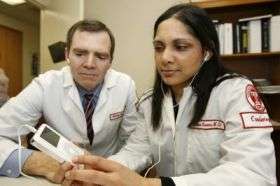
Patients rely on their physicians to recognize signs of trouble, yet for common heart murmurs, that ability is only fair at best. Fortunately, the solution is simple: listening repeatedly. In fact, intensive repetition — listening at least 400 times to each heart sound — significantly improved the stethoscope abilities of doctors, according to a study presented today at the American College of Cardiology's annual meeting.
After demonstrating last year that medical students greatly improved their stethoscope skills by listening repeatedly to heart sounds on their iPods, lead investigator Michael Barrett, M.D., clinical associate professor of medicine and cardiologist at Temple University School of Medicine and Hospital, set out to test the technique on practicing physicians.
During a single 90-minute session, 149 general internists listened 400 times to five common heart murmurs including aortic stenosis, aortic regurgitation, mitral stenosis, mitral regurgitation and innocent systolic murmur. Previous studies have found the average rate of correct heart sound identification in physicians is 40 percent. After the session, the average improved to 80 percent.
Proficiency with a stethoscope — and the ability to recognize abnormal heart sounds — is a critical skill for identifying dangerous heart conditions and minimizing dependence on expensive medical tests.
"It's important to know when to order a costly echocardiogram or stress test," said Barrett. "Plus, internists are now tested on this skill for board recertification. Requirements for residents and other specialists are sure to follow."
Listening to the heart, known as cardiac auscultation, is, Barrett believes, a technical skill and therefore best learned through intensive drilling and repetition, not by traditional methods, usually a classroom lecture or demonstration in medical school and then on the job.
"You don't build this proficiency by osmosis," Barrett said.
Barrett will lead another study of physicians, this time cardiologists, at the American College of Cardiology meeting in New Orleans on March 25 and 26 at 9 a.m. After the physicians' baseline stethoscope skills are tested, they will receive an iPod loaded with various heart sounds. After listening 400 times to each sound, they will be tested again to measure their improvement.
Temple University School of Medicine, where Barrett teaches, recently started a four-year curriculum on cardiac auscultation that relies on different types of simulators, including iPods, to teach medical students this important but vanishing skill.
For each year of medical school, heart sounds are posted online, allowing students to download them to an iPod or mp3 player. After listening repeatedly to the audio files, students' skills are tested.
Since the release of Barrett's first study with medical students, the demand for recordings of heart sounds has been intense. Thanks to a partnership with the American College of Cardiology, Barrett's heart sounds can now be accessed online and are available on CD.
He foresees a day in the near future when doctors are listening to heart sounds during their work commute.
"There are two times when a busy practitioner can learn a new skill: at professional meetings and during their work commute," observed Barrett. Consequently, he advised the ACC to make the CDs car-friendly and about the length of an average commute.
Source: Temple University


