Human skin harbors completely unknown bacteria
It appears that the skin, the largest organ in our body, is a kind of zoo and some of the inhabitants are quite novel, according to a new study. Researchers found evidence for 182 species of bacteria in skin samples. Eight percent were unknown species that had never before been described.
It is the first study to identify the composition of bacterial populations on the skin using a powerful molecular method. Not only were the bacteria more diverse than previously estimated, but some of them had not been found before, says Martin J. Blaser, M.D., Frederick King Professor and Chair of the Department of Medicine and Professor of Microbiology at NYU School of Medicine, one of the authors of the study.
"The skin is home to a virtual zoo of bacteria," he says. This study is published
February 5, 2007, in the online edition of the Proceedings of the National Academy of Sciences.
The researchers analyzed the bacteria on the forearms of six healthy subjects; three men and three women. "This is essentially the first molecular study of the skin," says Dr. Blaser. The skin has been, he says, terra incognita, an unknown world that he and his colleagues have set out to understand much like explorers.
"There are probably fewer than ten labs in the U.S. looking at this question," says Dr. Blaser. "It is very intensive work," he adds. Zhan Gao, M.D., senior research scientist in Dr. Blaser's lab, led the research, which took more than three years to complete.
Some of the bacteria on the skin appear to be more or less permanent residents; others are transient, according to the study.
This research is part of an emerging effort to study human microbial ecology. Dr. Blaser's laboratory has previously examined the bacterial population in the stomach and the esophagus. "Many of the bacteria of the human body are still unknown," he says. "We all live with bacteria all our lives and occasionally we smile, so they're not that bad for us."
The most numerous cells in our body are microbial—they outnumber our cells 10 to 1. The body has microbes native to the body, including the skin, and these populations change according to how we live, he says. "Ultimately what we want to do is compare disease and health," says Dr. Blaser. Keeping bacterial populations in our body stable may be part of staying healthy, he says.
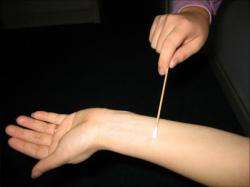
In the new study, the researchers took swabs from the inner right and left forearms of six individuals picking the region halfway between the wrist and the elbow for its convenience. "It's not where they wash their hands," explains Dr. Blaser. "And they don't have to undress." The researchers wanted to be able to compare two similar parts of the body. Because they also wanted to study change over time, they took swabs from four of the individuals 8 to10 months after the first test.
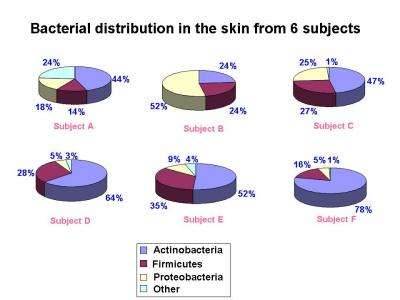
Roughly half, or 54.4%, of the bacteria identified in the samples represented the genera Propionibacteria, Corynebacteria, Staphylococcus and Streptococcus, which have long been considered more or less permanent residents in human skin.
The six individuals differed markedly in the overall composition of the bacterial populations on their skin. They only had four species of bacteria in common: Propionibacterium acnes, Corynebacterium tuberculostearicum, Streptococcus mitis, and Finegoldia AB109769. "This is a surprise," says Dr. Gao. "But many things affecting the skin affect bacteria, such as the weather, exposure to light, and cosmetics use."
Almost three-quarters, or 71.4%, of the total number of bacterial species were unique to individual subjects, suggesting that the skin surface is highly diversified in terms of the bacteria it harbors, according to the study.
Three bacterial species were only found in the male subjects: Propionibacterium granulosum, Corynebacterium singulare, and Corynebacterium appendixes. While the sample is too small to draw conclusions, the scientists believe that women and men may harbor some different bacterial species on their skin.
In each individual, the bacterial populations varied over time while revealing a core set of bacteria for each individual. "The predominant bacteria don't change much," says Dr. Gao. "But the more transient bacteria did change over time," she says.
"What that suggests," adds Dr. Blaser, "is that there is a scaffold of bacteria present in everybody's skin. Some stay and others come and go."
Finding the method
To obtain a sample Dr. Gao rubbed a swab on each individual's forearms. "We didn't tell them to be particularly clean, we just made sure they didn't take antibiotics up to one month prior to the test," Dr. Gao explains. She chose three men and three women to have a balance of genders. She set up a clean room so the samples didn't risk contamination.
Traditionally, bacteria are cultured in the lab in petri dishes, which contain a medium to grow bacteria. But the method leads to inaccuracies, she explains, because only a fraction of bacteria in a sample grow in that medium. So the team used a powerful molecular method that involved extracting a subunit of genetic material called 16S ribosomal DNA from the samples. "It is kind of a common currency, it's a conserved gene," says Dr. Blaser. Another advantage is that there is a large database of 16S ribosomal DNA available to scientists.
The ambitious task for this study was to gather samples, prepare them, amplify the bacteria creating colonies of each single species of bacteria present in the skin samples. Then Dr. Gao used established tools—primers—to pick out the species-specific genetic regions in the bacteria. After sequencing those regions, the 16S ribosomal DNA (rDNA) in each colony, she consulted 16S rDNA databases to determine the bacterial species present in each sample. Many bacteria in the database only exist as sequences and have nether been named or extensively studied. Those are termed SLOTUs, or species-level taxonomic units.
Taxonomy and the study results
To distinguish organisms from one another, biologists group and categorize them. Species or SLOTUs are small categories. There are larger groupings such as genera and phyla. Humans, for example, belong to the phylum chordata, the genus Homo and the species Homo sapiens.
The molecular method used in this study revealed differences between the bacterial populations in individuals. Other methods had previously not shown those differences.
The team found a total of 182 species or SLOTUs and 91 genera of bacteria in the skin samples.
The samples yielded mainly three phyla of bacteria: Actinobacteria, Firmicutes, and Proteobacteria. Ninety-four point six percent of the bacteria were in these phyla. These phyla were found in all six tested individuals. When compared with earlier studies, the researchers found that these three phyla are also dominant in the esophagus and the stomach. In terms of bacterial species, however, the insides of the body, for example the stomach, and the exterior of the body, the skin, show vast differences in bacterial populations.
Skin condition can change markedly due to a variety of factors such as climate, diet, personal hygiene, and disease. But skin is never devoid of bacteria, particularly its more permanent residents. That is not bad news, after all, in healthy individuals these bacteria are not pathogens. "Without good bacteria, the body could not survive," says Dr. Gao.
The next step for the research team is to look at diseased skin. "We plan to ask the question: Are the microbes in diseased skin, in certain diseases like psoriasis or eczema, different than the microbes in normal skin?" says Dr. Blaser.
Source: New York University Medical Center


