Global maps created to show malaria hotspots
Dec 04, 2006
Global maps created to show malaria hotspots
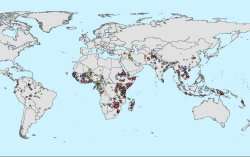
Map of where malaria has been sampled in populations between 1985 and 2006, from the website. (See www.map.ox.ac.uk)

Global maps are being created that will define, for the first time in over 40 years, the distribution of malaria risk worldwide. The atlas will help those involved in malaria control.

The Malaria Atlas Project (MAP), a collaboration between the Kenya Medical Research Institute and the University of Oxford, has been funded by the Wellcome Trust to produce the maps. Its goals are described in PLoS Medicine this month.

Dr Simon Hay in Oxford’s Zoology Department, a member of the MAP team, said: ‘The aim of the project is not just to assemble data but to link these information to environmental and population data and make continuous global maps of malaria risk to help rationalise control.’

Across the world malaria scientists collect information on how many people are infected with malaria parasites. Never before have all the data been gathered into a single source and linked to a map of the world. MAP has so far assembled information from 3126 communities in 79 countries, and represents the single largest repository of contemporary information on malaria risk to date.

MAP intends to give open access to its data, so that it can help anyone and everyone involved in malaria control. A member of the team has developed an interface between the MAP data and Google Earth.

‘How we design malaria control and measure its impact depends on knowing how much malaria exists in a given area,’ says Professor Bob Snow from the Centre for Tropical Medicine at Oxford and based at the Centre for Geographic Medicine in Nairobi. ‘Like any war, knowing where your enemy is located and in what strength determines how you engage them.’

For more information see www.map.ox.ac.uk .

Source: University of Oxford

Explore further: FDA warns of infections tied to Tennessee pharmacy

add to favorites email to friend print save as pdf

Related Stories

Researchers map primate networks to predict pandemics

Apr 23, 2013

(Phys.org) —Most emerging infectious diseases (EIDs) that affect humans originated in animals. However, epidemiologists have been unable to identify the sources of zoonotic diseases until after they have ...

Satellites in the developing world

Aug 05, 2011

Within 24 hours of the catastrophic 2010 earthquake near Port-au-Prince, Haiti, space agencies and companies around the world tasked satellites with providing free images of the earthquake’s aftermath. ...

Researchers map 'fly tree of life'

Mar 14, 2011

Calling it the "new periodic table for flies," researchers at North Carolina State University and collaborators across the globe have mapped the evolutionary history of flies, providing a framework for further comparative ...

Recommended for you

Top-ranked golfer beats scoliosis

16 hours ago

(HealthDay)—As a world-class golfer, Stacy Lewis' accomplishments are remarkable. But it was a physical challenge in her childhood that defined her ascent to the top of her sport.

WHO: Scientific red tape mars efforts vs. virus

May 23, 2013

International efforts to combat a new pneumonia-like virus that has now killed 22 people are being slowed by unclear rules and competition for the potentially profitable rights to disease samples, the head ...

User comments : 0

More news stories

Galaxies fed by funnels of fuel

(Phys.org) —Computer simulations of galaxies growing over billions of years have revealed a likely scenario for how they feed: a cosmic version of swirly straws.