HIV gets a makeover: A few adjustments to the AIDS virus could alter the course of research
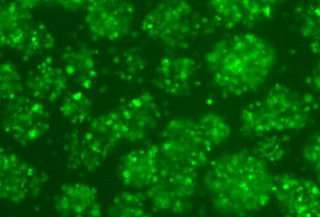
The slow pace of AIDS research can be pinned, in no small part, on something akin to the square-peg-round-hole conundrum. The HIV-1 virus won’t replicate in monkey cells, so researchers use a monkey virus — known as SIVmac, or the macaque version of simian immunodeficiency virus — to test potential therapies and vaccines in animals. But therapies and vaccines that are effective on SIV don’t necessarily translate into human success.
Now, using a combination of genetic engineering and forced adaptation, researchers at Rockefeller and the Aaron Diamond AIDS Research Center have created a version of the AIDS virus that replicates vigorously in both human and monkey cells — an advance that has the potential to revolutionize vaccine research.
In a paper published in the last issue of Science, Paul Bieniasz, associate professor and head of the Laboratory of Retrovirology, describes how he and his colleagues maneuvered around the intrinsic immunity of primate cells by replacing just a few parts of the human virus — the ones responsible for blocking replication in monkey cells — with components from SIV. “Overall, the virus is a mixture of engineering and forced evolution,” Bieniasz says. “It sounds simple, in theory, but it took us two years to do.”
Bieniasz and Theodora Hatziioannou, a research scientist in the lab and the paper’s first author, had to overcome two major obstacles: the first was a protein called TRIM5 that, in monkeys, recognizes the outer shell or “capsid” of HIV-1 but not that of SIV. By swapping out the capsid region of the HIV-1 genome for that of the monkey virus, and then selectively growing the viruses that replicated most robustly, over several generations Hatziioannou created an HIV-1 mutant that could evade the monkey cells’ TRIM5 recognition.
Another bit of engineering was required to get around the second obstacle: APOBEC proteins produced by a host normally cause invading viruses to mutate so much that they can’t survive, but HIV-1 uses a protein called Vif to destroy APOBEC and prevent the attack. Monkey APOBEC proteins, however, aren’t susceptible to the human virus’s Vif. So Hatziioannou did another swap — the SIV Vif gene for the HIV one — and then another round of forced adaptation to create viruses that would multiply with vigor.
The researchers dubbed their end result simian tropic HIV (stHIV): a form of HIV-1 that only differs from the original by about 10 percent, but can effectively infect primate cells and be used to test potential therapies. “If we can make this virus work in animals the way it works in tissue culture, it will likely change the way that AIDS vaccine and therapeutics research is done,” Bieniasz says.
Source: Rockefeller University


