World's first transcontinental anesthesia
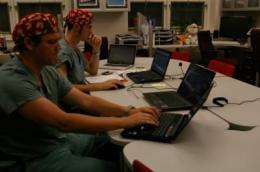
Videoconferences may be known for putting people to sleep, but never like this. Dr. Thomas Hemmerling and his team of McGill's Department of Anesthesia achieved a world first on August 30, 2010, when they treated patients undergoing thyroid gland surgery in Italy remotely from Montreal. The approach is part of new technological advancements, known as 'Teleanesthesia', and it involves a team of engineers, researchers and anesthesiologists who will ultimately apply the drugs intravenously which are then controlled remotely through an automated system.
This achievement is a product of an on-going scientific collaboration between Dr. Hemmerling's team and the Italian team of Dr. Zaouter of the Department of Anesthesia of Pisa University (Chairman Prof. Giunta).
"The practice has obvious applications in countries with a significant number of people living in remote areas, like Canada, where specialists may not be available on site," Hemmerling said. "It could also be used for teaching purposes, allowing the resident to perform tasks without the physical presence of a tutor, thus increasing his or her confidence level."
Four strategically placed video cameras monitored every aspect of patient care in Pisa, Italy, in real time. Ventilation parameters (such as the patient's breathing rate), vital signs (ECG, heart rate, oxygen saturation) and live images of the surgery are monitored by each camera, with the fourth used for special purposes. A remote computer station ('anesthesia cockpit') is required, as is a workstation that handles the audio-video link between the two centres. "Obviously, local anesthesiologists can override the process at any time," Hemmerling explained. Prior to the operation, an assessment of the patient's airway and medical history is also performed via video-conferencing.
The researchers are also looking at the possibility of preoperative assessment of patients at home. It used to be that invasive blood tests or other tests were required in preparation for many surgeries, but that's no longer the case. Many patients take very long journeys and often wait hours to see an anesthesiologist who will ask them specific questions, but video-conferencing could eliminate these logistical problems and probably reduce the preoperative stress of the patients coming into the hospital before surgery. "The next steps will be to confirm the results of this pilot experience with further studies," Hemmerling said.
More information: For more information: www.newanesthesia.com


