Soldiers' helmets could control brain activity with ultrasound
Sep 10, 2010 by Lisa Zyga weblog
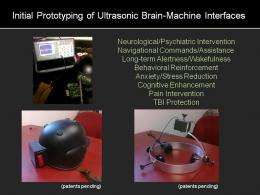
(Lower left) A ballistic helmet fitted with four ultrasound transducers and (lower right) another functional prototype for achieving human brain stimulation using a single element transducer, as well as a list of potential applications relevant to the defense industry. Image credit: Tyler Lab.

(PhysOrg.com) -- One of DARPA's latest pursuits of cutting-edge research involves a neurotechnology lab at Arizona State University that specializes in ultrasonic brain stimulation. By implementing the technology in soldiers' helmets, DARPA hopes to provide advantages to US troops by enhancing cognitive abilities; improving long-term alertness; and reducing stress, anxiety, and pain.

The research lab is run by neuroscientist William Tyler, who has been investigating non-invasive approaches to for many years. Some of the applications of brain stimulation include treating such as Parkinson's and depression, as well as enabling the development of brain-computer interfaces.

As Tyler explains in a recent blog post, two of the biggest challenges in brain stimulation are achieving high spatial resolution (for precise control of ) and deep penetration (for reaching all parts of the brain). Currently, some brain stimulation techniques require surgically implanting electrodes to achieve these goals, and non-surgical techniques tend to lack in one or both areas. But Tyler has developed a noninvasive technique in which “transcranial pulsed ultrasound” can remotely stimulate without the need for surgery. The pulsed ultrasound approach can provide a spatial resolution that is about five times greater than other non-surgical techniques and can reach deep-brain circuits to the same depth as surgical techniques.

With the new grant from DARPA, the lab is now turning its attention toward developing applications for US soldiers. Instead of using the technology to repair damaged brain circuits, the researchers are exploring how ultrasound can affect healthy brain circuits. They have developed working and conceptual prototypes of ballistic helmets embedded with ultrasound transducers and microcontroller devices. One of the most important applications may be minimizing the effects of a (TBI), as Tyler explained to Wired.

“The really damaging part of a TBI isn’t the initial injury,” he said. “It’s the metabolic damage, the free radicals and the swelling that are happening in the hours afterward. If you can flick your remote and trigger an immediate intervention, you’d be curbing what might otherwise be lifelong brain damage.”

Explore further: Clouds in the head

More information: via: Armed With Science and Wired

Related Stories

A pacemaker for your brain

Jun 28, 2010

By stimulating certain areas of the brain, scientists can alleviate the effects of disorders such as depression or Parkinson's disease. That's the good news. But because controlling that stimulation currently lacks precision, ...

Researchers Develop Wireless Method of Brain Stimulation

Mar 16, 2009

(PhysOrg.com) -- A new, wireless method of brain stimulation has the potential to activate specific regions of the brain or restore function to damaged or cut nerves, according to a study by Case Western Reserve ...

Shedding some light on Parkinson's treatment

Apr 16, 2009

A research team lead by Karl Deisseroth in the bioengineering department at Stanford University has developed a technique to systematically characterize disease circuits in the brain. By precisely controlling ...

Recommended for you

Reducing caloric intake delays nerve cell loss

14 hours ago

Activating an enzyme known to play a role in the anti-aging benefits of calorie restriction delays the loss of brain cells and preserves cognitive function in mice, according to a study published in the May ...

B vitamins could delay dementia

18 hours ago

(Medical Xpress)—Despite spending billions of dollars on research and development, drug companies have been unable to come up with effective treatments for dementia and Alzheimer's Disease (AD). Now, A. ...

If you can remember it, you can remember it wrong

20 hours ago

(Medical Xpress)—Native peoples in regions where cameras are uncommon sometimes react with caution when their picture is taken. The fear that something must have been stolen from them to create the photo ...

Study shows where scene context happens in our brain

22 hours ago

In a remote fishing community in Venezuela, a lone fisherman sits on a cliff overlooking the southern Caribbean Sea. This man –– the lookout –– is responsible for directing his comrades on the water, ...

Clouds in the head

23 hours ago

Many brain researchers cannot see the forest for the trees. When they use electrodes to record the activity patterns of individual neurons, the patterns often appear chaotic and difficult to interpret.

User comments : 24

Adjust slider to filter visible comments by rank

Display comments: newest first

davaguco
5 / 5 (8) Sep 10, 2010
Remotely controlling soldier's brains is something that scares me a bit. Maybe I'm a bit paranoid.
nuge
5 / 5 (14) Sep 10, 2010
I thought this sounded like a bad idea, but then my helmet told me to quit worrying.
hodzaa
2.3 / 5 (3) Sep 10, 2010
Ultrasound is used during liposuction, too. It makes fat tissue pretty fluid.
DeadCorpse
4.5 / 5 (8) Sep 10, 2010
Reduce the fear response, bolster the impulse to follow orders, ignore pain signals, amp up aggression, quell moral reflex...

What could go wrong?
Sinister181
3 / 5 (2) Sep 10, 2010
"With the new grant from DARPA, the lab is now turning its attention toward developing applications for US soldiers. Instead of using the technology to repair damaged brain circuits, the researchers are exploring how ultrasound can affect healthy brain circuits."

Yeah, because there's such a huge demand for it in that area..
Ravenrant
5 / 5 (3) Sep 10, 2010
Mind control helmets. No need to worry about big brother watching, he'll reside in your head. I wonder where where this could go. If they can do it in a helmet how long before an implant will follow? First it will be soldiers, then child molesters, then rowdy inmates, then alcoholics and drug addicts. Go a little farther? How about it stimulating the brains pleasure areas? Sounds like an old sc-fi story. Drugs where passe and addicts used a device like that called a drowd. Yeah, nice technology, no potential for abuse there.
NotAsleep
3 / 5 (2) Sep 10, 2010
This helmet has the same effect as over the counter or prescription drugs. What's everyone's REAL moral dilemma?
snwboardn
2.5 / 5 (2) Sep 10, 2010
This helmet has the same effect as over the counter or prescription drugs. What's everyone's REAL moral dilemma?


Well when the kid comes home and goes on a shooting spree or kills his girlfriend... Or throws a grenade into a crowd of civilians while he is stationed in Iraq... How can you really prove beyond a reasonable doubt that the headgear didn't make him go crazy? Sounds like too much liability to me.

NotAsleep
5 / 5 (1) Sep 10, 2010
Well when the kid comes home and goes on a shooting spree or kills his girlfriend... Or throws a grenade into a crowd of civilians while he is stationed in Iraq... How can you really prove beyond a reasonable doubt that the headgear didn't make him go crazy? Sounds like too much liability to me.


How can you prove beyond a reasonable doubt it wasn't something in the water? Kids already do those things you mentioned. I'm not trying to say it's a great idea, my point was that if you demonize the "brain helmet", you also have to demonize alcohol, caffeine, pot, "spice", chocolate, ibuprofen, sniffing glue and whatever else people do these days to affect how they perceive the environment around them and how they perceive themselves
maxcypher
not rated yet Sep 10, 2010
Big Brother is already watching you, this is just an added refinement. Everything will be reduced to a pill filled with nanomachines anyways.
plasticpower
4 / 5 (2) Sep 10, 2010
I need a helmet that makes me perceive time faster at work. 8 hours feels so long..
Oxensraiser?
2 / 5 (2) Sep 10, 2010
I saw someone metion the idea of Niven's Droud unit for wireheading, but the far more disturbing thought is if they make a Tasp type weapon. Something that can make you change your mind with the push of a button... or turn you into a slave by setting the pleasure centers off in your head till your a drooling puddle, and willing to do anything for just one more shot.....
robbor
4 / 5 (1) Sep 10, 2010
The Manchurian Candidate x platoon
Cave_Man
1 / 5 (1) Sep 12, 2010
I thought this sounded like a bad idea, but then my helmet told me to quit worrying.

i like how you think, because it is how i think now too, thanks to the helmet....;)
Cave_Man
1 / 5 (1) Sep 12, 2010
Big Brother is already watching you, this is just an added refinement. Everything will be reduced to a pill filled with nanomachines anyways.

While I agree completely....I don't know where I was going with that.
Sinister181
1 / 5 (1) Sep 12, 2010
I need a helmet that makes me perceive time faster at work. 8 hours feels so long..


LOL! I know how you feel.. I think we all need a helmet with that function. Now THAT would be worthwhile technology.
jjoensuu
not rated yet Sep 12, 2010
hmmm...an article about brain control...and the helmet in the attached picture looks like something designed in Nazi Germany during WW2...
AnnieG
1 / 5 (1) Sep 12, 2010
I find this the most disturbing thing I have ever read in my life so far!! Research like this should never be allowed.
Paradox
not rated yet Sep 13, 2010
Although there are great possibilities for medicine, absolute power corrupts absolutely...
LoveKraft
not rated yet Sep 13, 2010
First damage brains with fluoride and monosodium glutamate and whatever else...
Then you can "heal" the remaining healthy parts.
What could possibly go wrong with an army of brain dead people wearing a mind control helmet?
O2BOOM
not rated yet Sep 13, 2010
Reduce the fear response, bolster the impulse to follow orders, ignore pain signals, amp up aggression, quell moral reflex...

What could go wrong?

All of these can be done with focus.
Perhaps this type of technology will be more useful on less trained individuals?

johnnyRocket
5 / 5 (1) Sep 13, 2010
These aren't the droids you're looking for...
move along now...
jjoensuu
not rated yet Sep 14, 2010
hehe, came to think about that helmet shape when I read this article:

Did Hitler die in 1945?
http://www.unexpl...d=190211
jimbo92107
not rated yet Sep 18, 2010
I need a helmet that...um...I don't remember. Oh, wait! Nope, not that either.

I need a helmet!

More news stories

Italy approves law on controversial stem cell therapy

Italian lawmakers on Wednesday gave their final approval to a law that allows limited use of a controversial type of stem cell therapy which has been condemned by many scientists but has given hope to families of terminally-ill ...

Study says empathy plays a key role in moral judgments

Is it permissible to harm one to save many? Those who tend to say "yes" when faced with this classic dilemma are likely to be deficient in a specific kind of empathy, according to a report published in the scientific journal ...

Sony mulls hedge fund's entertainment sale idea

Sony's CEO Kazuo Hirai says the electronics giant's board will discuss a proposal by U.S. hedge fund manager Daniel Loeb to spin off up to 20 percent of its movie, TV and music division.

Social media puts HR ethics under the spotlight

Social media has definitely changed the game for job-seekers and recruiters. Traditionally, HR recruiters placed an advertisement, sifted through the responses, and interviewed the shortlisted candidates ...