Single gene regulates motor neurons in spinal cord
Sep 08, 2010
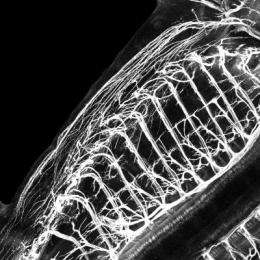
This image shows the pattern of motor neuron innervation in the body of a mouse embryo. Credit: Image courtesy of Heekyung Jung

In a surprising and unexpected discovery, scientists at NYU Langone Medical Center have found that a single type of gene acts as a master organizer of motor neurons in the spinal cord. The finding, published in the September 9, 2010 issue of Neuron, could help scientists develop new treatments for diseases such as Lou Gehrig's disease or spinal cord injury.

The "master organizer" is a member of the Hox family of genes, best known for controlling the overall pattern of body development. By orchestrating a cascade of in the early embryo, Hox genes allow for the creation of an animal's overall structure and body part orientation. Scientists first discovered the genes in but they have since detected Hox activity in mammals. Humans harbor 39 such genes and 21 have been identified as coordinating in the spinal cord.

"We knew that there were 21 Hox genes that determine how connections are made between motor neurons in the spinal cord and muscles in the limbs," says Jeremy S. Dasen, PhD, an associate professor in the Departments of Physiology and Neuroscience at NYU Langone Medical Center and a Howard Hughes Medical Institute Early Career Scientist. "But what was surprising to us in this study was that a single Hox gene acts as a global organizer of motor neurons and their connections. The next step will be to see how Hoxc9 in motor neurons affect motor behaviors such as walking and breathing."

In mammals, many hundreds of motor neurons are needed to control the variety of used to coordinate movement. Proper function depends on each of these neurons in the embryo finding its way from the spinal cord to the group of muscles that it is equipped to control. Dr. Dasen and his colleagues have been working to discover the blueprint for this motor neuron diversity.

For this study, scientists studied mice with a mutation in Hoxc9 gene. They analyzed the molecular markers that distinguished between motor neurons in the limb and thoracic area and discovered mutation of Hoxc9 transformed the thoracic motor neurons into limb motor neurons. In a series of biochemical experiments they further showed that Hoxc9 orchestrates gene expression in motor neurons by repressing the dedicated to limb coordination.

"What we are trying to understand is how the nervous system is wired to control movements such as breathing and walking and see how genetic programs can further control these circuits in terms of exploring this paradigm as a way at looking at the vital circuits of the body," adds Dr. Dasen.

Explore further: Study shows where scene context happens in our brain

add to favorites email to friend print save as pdf

Related Stories

Evolution of new brain area enables complex movements

Jan 12, 2009

A new area of the cerebral cortex has evolved to enable man and higher primates to pick up small objects and deftly use tools, according to neuroscientists at the University of Pittsburgh School of Medicine and Pittsburgh's ...

A fine balance

Oct 08, 2008

Once a toddler has mastered the art of walking, it seems to come naturally for the rest of her life. But walking and running require a high degree of coordination between the left and right sides of the body. ...

Antioxidant controls spinal cord development

Sep 18, 2009

Researchers at the Johns Hopkins School of Medicine have discovered how one antioxidant protein controls the activity of another protein, critical for the development of spinal cord neurons. The research, publishing this ...

Recommended for you

Reducing caloric intake delays nerve cell loss

13 hours ago

Activating an enzyme known to play a role in the anti-aging benefits of calorie restriction delays the loss of brain cells and preserves cognitive function in mice, according to a study published in the May ...

B vitamins could delay dementia

17 hours ago

(Medical Xpress)—Despite spending billions of dollars on research and development, drug companies have been unable to come up with effective treatments for dementia and Alzheimer's Disease (AD). Now, A. ...

If you can remember it, you can remember it wrong

19 hours ago

(Medical Xpress)—Native peoples in regions where cameras are uncommon sometimes react with caution when their picture is taken. The fear that something must have been stolen from them to create the photo ...

Study shows where scene context happens in our brain

21 hours ago

In a remote fishing community in Venezuela, a lone fisherman sits on a cliff overlooking the southern Caribbean Sea. This man –– the lookout –– is responsible for directing his comrades on the water, ...

Clouds in the head

23 hours ago

Many brain researchers cannot see the forest for the trees. When they use electrodes to record the activity patterns of individual neurons, the patterns often appear chaotic and difficult to interpret.

User comments : 0

More news stories

Study says empathy plays a key role in moral judgments

Is it permissible to harm one to save many? Those who tend to say "yes" when faced with this classic dilemma are likely to be deficient in a specific kind of empathy, according to a report published in the scientific journal ...

If you can remember it, you can remember it wrong

(Medical Xpress)—Native peoples in regions where cameras are uncommon sometimes react with caution when their picture is taken. The fear that something must have been stolen from them to create the photo ...

B vitamins could delay dementia

(Medical Xpress)—Despite spending billions of dollars on research and development, drug companies have been unable to come up with effective treatments for dementia and Alzheimer's Disease (AD). Now, A. ...

First Look: New Xbox elegant, but much unknown

Will gamers want One? After four years of development, Microsoft unveiled the Xbox One entertainment console and touted it as an all-in-one solution for playing games, watching TV and doing everything in ...

Sony mulls hedge fund's entertainment sale idea

Sony's CEO Kazuo Hirai says the electronics giant's board will discuss a proposal by U.S. hedge fund manager Daniel Loeb to spin off up to 20 percent of its movie, TV and music division.

Apple case seen as possible spur to tax action

Now that tech favorite Apple Inc. has been dragged front and center into the debate over the U.S. tax code, lawmakers are hoping that the spotlight on such a high-profile company could be the catalyst for ...