Natural lung material is promising scaffold for engineering lung tissue using embryonic stem cells
Aug 19, 2010
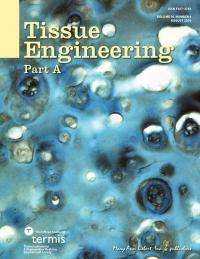
Tissue Engineering is published 24 times a year in print and online. Credit: Mary Ann Liebert

The first successful report of using cell-depleted lung as a natural growth matrix for generating new rat lung from embryonic stem cells is presented in a breakthrough article in Tissue Engineering, Part A, a peer-reviewed journal published by Mary Ann Liebert, Inc.

Embryonic stem cells (ESCs) have the potential to mature into virtually any type of cell and tissue type, but they require an appropriate environment and to drive their differentiation into specific cell types and to form 3-dimensional tissue structures. Alternatives to available synthetic tissue matrices are needed to drive this technology forward and develop clinical applications for engineered lung tissue.

Joaquin Cortiella, MD, MPH, and colleagues from University of Texas Medical Branch (Galveston), Stanford University (Palo Alto, CA), Brown Medical School (Providence, RI), and Duke University (Durham, NC), describe the first attempt to make acellular rat lung and use it as a biological matrix for differentiating ESCs into lung tissue. The authors present evidence of improved cell retention, repopulation of the matrix, and differentiation into the cell types present in healthy lung. They also report signs that the cells are organizing into the 3-D structures characteristic of complex tissues and are producing the chemical signals and growth factors that guide lung tissue function and development.

Cortiella and coauthors describe the process used to remove the cellular component of natural and create a growth matrix for ESCs in the article, "Influence of Acellular Natural Lung Matrix on Murine Embryonic and Tissue Formation."

"Organ-specific extracellular matrices, properly prepared, are serving more and more as the appropriate structural scaffold for the recapitulation of a specific organ's tissues. This turns out to be especially true in an organ such as the lung, whose parenchyma must have a structure that accommodates atmospheric gas transmission as well as vascular, lymphatic, and neural systems," says Peter C. Johnson, MD, Co-Editor-in-Chief of Tissue Engineering and Vice President, Research and Development, Avery Dennison Medical Products.

Explore further: Baby's life saved with groundbreaking 3-D printed device that restored his breathing

More information: The article is available free online at www.liebertpub.com/ten

Provided by Mary Ann Liebert, Inc.

5 /5 (1 vote)
add to favorites email to friend print save as pdf

Related Stories

Scientists grow new lungs using 'skeletons' of old ones

Jun 24, 2010

For someone with a severe, incurable lung disorder such as cystic fibrosis or chronic obstructive pulmonary disease, a lung transplant may be the only chance for survival. Unfortunately, it's often not a very good chance. ...

Lung tissue generated from human embryonic stem cells

Nov 05, 2009

Scientists in Belgium have successfully differentiated human embryonic stem cells (hESC) into major cell types of lung epithelial tissue using a convenient air-liquid interface. The technique, published in BioMed Central's ...

Hydrogels provide scaffolding for growth of bone cells

Aug 17, 2008

Hyaluronic hydrogels developed by Carnegie Mellon University researchers may provide a suitable scaffolding to enable bone regeneration. The hydrogels, created by Newell Washburn, Krzysztof Matyjaszewski and Jeffrey Hollinger, ...

Recommended for you

Scientists discover molecule triggers sensation of itch

13 hours ago

Scientists at the National Institutes of Health report they have discovered in mouse studies that a small molecule released in the spinal cord triggers a process that is later experienced in the brain as ...

Discarded immune cells induce the relocation of stem cells

15 hours ago

Spanish researchers have discovered that the daily clearance of neutrophils from the body stimulates the release of hematopoietic stem cells from the bone marrow into the bloodstream, according to a report published today ...

User comments : 0

More news stories

Controlling mood through the motions of mitochondria

(Medical Xpress)—Regulating the distribution of power in neurons is done by a system that makes the national electric grid look simple by comparison. Each neuron has several thousand mitochondria confined ...

Ferrets, pigs susceptible to H7N9 avian influenza virus

Chinese and U.S. scientists have used virus isolated from a person who died from H7N9 avian influenza infection to determine whether the virus could infect and be transmitted between ferrets. Ferrets are often used as a mammalian ...

A hidden population of exotic neutron stars

(Phys.org) —Magnetars – the dense remains of dead stars that erupt sporadically with bursts of high-energy radiation - are some of the most extreme objects known in the Universe. A major campaign using ...

A quantum simulator for magnetic materials

Physicists understand perfectly well why a fridge magnet sticks to certain metallic surfaces. But there are more exotic forms of magnetism whose properties remain unclear, despite decades of intense research. ...