Compact microscope a marvel
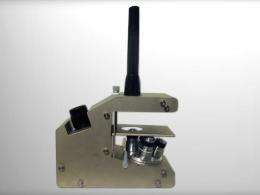
A compact microscope invented at Rice University is proving its potential to impact global health. In a paper published online today in the journal PLoS ONE, Rice alumnus Andrew Miller and co-authors show that his portable, battery-operated fluorescence microscope, which costs $240, stacks up nicely against devices that retail for as much as $40,000 in diagnosing signs of tuberculosis.
Miller and colleagues at The Methodist Hospital Research Institute (TMHRI) analyzed samples from 19 patients suspected of having TB, an infectious disease that usually attacks the lungs and can be fatal if not treated. His instrument, called the Global Focus microscope, performed just as well as the lab's reference-standard fluorescence microscope. The team reported similar findings were obtained in 98.4 percent of the samples tested.
Miller created the 2.5-pound microscope as his senior design project last year, working with faculty in Rice 360˚: Institute for Global Health Technologies. The goal was to make an inexpensive, portable and highly capable microscope that could be used in clinics in developing countries that have limited access to lab equipment and may lack electricity.
The microscope was built with off-the-shelf parts encased in a rugged plastic shell Miller created with a 3-D printer at Rice's Oshman Engineering Design Kitchen (OEDK). Light to power the 1,000-times magnification microscope comes from a top-mounted LED flashlight.
The Global Focus microscope won this year's Hershel M. Rich Invention Award, which is presented annually by Rice Engineering Alumni to a Rice faculty member or student who has developed an original invention. It was the first undergraduate project to win the award.
Miller graduated from Rice in 2009 with a degree in bioengineering and works full time as a medical device designer for Thoratec, a San Francisco company that makes ventricular assist devices. Part time, he continues working to commercialize the microscope in a way that will ensure its cost remains low for users in developing countries. He has also replaced the microscope's plastic casing with aluminum for better stability.
Miller and Rice have contracted with a medical device consultant, 3rd Stone Design, to produce 20 microscopes that will be ready for field testing next month.
"The World Health Organization estimates that 1.3 million people died from tuberculosis in 2008," said Rebecca Richards-Kortum, Rice's Stanley C. Moore Professor of Bioengineering and the founding director of Rice 360°. "Andy's microscope, which is portable, durable and inexpensive, could be used to diagnose tuberculosis in community or rural health centers with limited infrastructure in the developing world, promoting early detection and successful treatment of the disease."
The trial used TB smear samples from Tehran, Iran. Ahmad Bahrmand, former TB laboratory director of the Pasteur Institute of Iran, brought sputum smear samples from the infected patients when he came to work for Edward Graviss, director of the TMHRI Molecular Tuberculosis Laboratory.
Four days of blind testing of 63 smear samples, including control slides, confirmed the Global Focus microscope was every bit as capable as the lab's more sophisticated instrument in identifying positive smear specimens.
"This is hugely significant as a point-of-care tool clinicians can use for tuberculosis patients, whether they're in Asia or Africa or even in West Texas," Graviss said. "The first identification of TB is usually made with a smear, and it will be good to know that in the field instead of having to wait three or four days to get the smear to a lab.
"The idea was to compare a field-grade type microscope with what we see in a standard TB laboratory, such as what we have at Methodist," he said. "When we compared the results between the two microscopes, there was no significant difference. The quality is there, and you're not going to miss anything by using one of these point-of-care microscopes."
A new team of Rice students is developing software to help untrained clinicians to diagnose tuberculosis in the field through image processing on a smart phone, perhaps as an iPhone app.
More information: Read the paper here: www.plosone.org/article/info%3Adoi%2F10.1371%2Fjournal.pone.0011890


