The role of calcium in Randall's plaques (kidney stones)
May 31, 2010
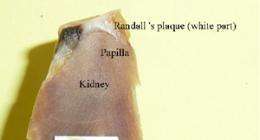
In the photo the Randall plaque can be clearly seen as the white part at the top of the renal papilla. Copyright: X. Carpentier et al., 2010.

Randall's plaques are soft tissue calcifications found in the deep renal medulla skirting the surface of the epithelium of the papilla, where they act as nucleating elements for renal calculi or stones. These plaques have been described until now as composed of carbapatite (poorly crystallized carbonated calcium phosphate or carbonated apatite, abbreviated to CA). Characterization of these plaques in real environments has led to more surprising results.

A group consisting of physicists from the Laboratoire de Physique des Solides and the DIFFABS beamline at SOLEIL, in collaboration with doctors at the Necker Hospital, have carried out for the first time the characterization of a Randall plaque positioned on its renal papilla. More precisely, they carried out X-ray experiments at the Ca K-edge on DIFFABS.

The researchers were able to study the exact nature and proportions of the mineral phases present in the Randall plaque when moving from the top of the papilla towards the deep medulla without the need for preparation protocols that might alter the sample’s physicochemical state. They then showed that the absorption spectra obtained looked more like that of amorphous carbonated (ACCP) than that of CA, therefore revealing that Randall plaques could be composed mainly of ACCP and not of CA.
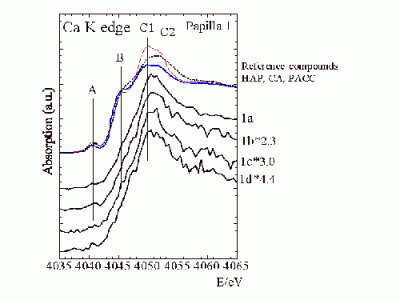
Spectrum: XANES part of the absorption spectra for the papilla 1. Copyright: X. Carpentier et al., 2010.

This result, in apparent contradiction to that stated in published literature, is easily explained if one takes into account the fact that the level of water in the sample governs the transition between ACCP and CA, of which it is the precursor. In earlier studies, the samples were dehydrated, which could have modified the phase transition from ACCP to CA, whereas, in these experiments, the water levels were maintained; the Randall could then be characterized while keeping its physicochemistry intact.

It should be noted that ACCP is evidence of an oversaturation in calcium phosphate by an excess of calcium and/or phosphate and/or due to too high a pH. Its presence in increasingly young subjects raises the question: does nutrient-enriched food specially aimed at young children affect the physiology of the kidney? The debate is open.

Explore further: How healthy are you for your age?

More information: The pathogenesis of Randall's plaque: a papilla cartography of Ca compounds through an ex vivo investigation based on XANES spectroscopy, The Journal of Synchrotron Radiation (2010). 17, 374-379. DOI:10.1107/S0909049510003791

add to favorites email to friend print save as pdf

Related Stories

Artificial Cells

Nov 10, 2005

Do cells always have to be developed from organic carbon-containing compounds? When resourceful scientists stretch their imaginations, they quickly find an answer to this question. This is demonstrated by the work of Achim ...

Imaging fat layer around heart can help predict disease

Mar 15, 2010

Imaging epicardial adipose tissue, or the layer of fat around the heart, can provide extra information compared with standard diagnostic techniques such as coronary artery calcium scoring, according to research by cardiologists ...

Carbonate veins reveal chemistry of ancient seawater

Feb 05, 2010

The chemical composition of our oceans is not constant but has varied significantly over geological time. In a study published this week in Science, researchers describe a novel method for reconstructing past o ...

Recommended for you

Study reveals active site of enzyme linked to stuttering

13 minutes ago

(Medical Xpress)—Scientists from the Joint Center for Structural Genomics (JCSG) at SLAC National Accelerator Laboratory have determined the 3-D structure of the chemically active part of an enzyme involved ...

How healthy are you for your age?

23 hours ago

On May 22, JoVE will publish details of a technique to measure the health of human genetic material in relation to a patient's age. The method is demonstrated by the laboratory of Dr. Gil Atzmon at New York's Albert Einste ...

User comments : 0

More news stories

Cold plasma successful against brain cancer cells

For the first time, physicists from the Max Planck Institute for Extraterrestrial Physics (MPE), biologists and physicians demonstrated the synergistic effect of cold atmospheric plasma - a partly ionized ...

Key find for early bladder cancer treatment

Aggressive forms of bladder cancer involve the protein PODXL – a discovery that could hold the key to improved treatment, according to researchers at Lund University, Uppsala University and KTH in Sweden.

Can you put a price on health?

As health services strive to improve quality and reduce costs, researchers study the benefits – and the pitfalls – of 'pay for performance' in hospitals.

Researchers forward quest for quantum computing

Research teams from UW-Milwaukee and the University of York investigating the properties of ultra-thin films of new materials are helping bring quantum computing one step closer to reality.

Chemists find new compounds to curb staph infection

(Phys.org) —In an age when microbial pathogens are growing increasingly resistant to the conventional antibiotics used to tamp down infection, a team of Wisconsin scientists has synthesized a potent new ...

Wildlife losses now stabilising

Efforts to conserve biodiversity in the UK, Belgium and Netherlands may be working, despite the widespread perception that wildlife is in terminal decline, a new study suggests.