Substance in breast milk kills cancer cells
Apr 19, 2010
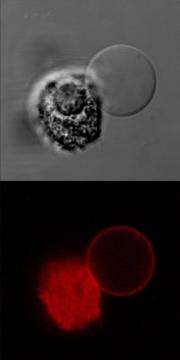
Microscope images that show HAMLET's interaction with biological membranes. Using a red, fluorescent substance that shows the location of HAMLET, the researchers can clearly demonstrate that it binds to the cell membrane of a tumor cell. Credit: University of Gothenburg

A substance found in breast milk can kill cancer cells, reveal studies carried out by researchers at Lund University and the University of Gothenburg, Sweden.

Although the special substance, known as HAMLET (Human Alpha-lactalbumin Made LEthal to ), was discovered in breast milk several years ago, it is only now that it has been possible to test it on humans. Patients with cancer of the bladder who were treated with the substance excreted dead in their urine after each treatment, which has given rise to hopes that it can be developed into medication for cancer care in the future.

Discovered by chance

HAMLET was discovered by chance when researchers were studying the antibacterial properties of breast milk. Further studies showed that HAMLET comprises a protein and a fatty acid that are both found naturally in . So far, however, it has not been proven that the HAMLET complex is spontaneously formed in the milk. It is speculated, however, that HAMLET can form in the acidic environment of the babies´ stomachs. Laboratory experiments have shown that HAMLET kills 40 different types of cancer, and the researchers are now going on to study its effect on , tumours in the mucous membranes and brain tumours. Importantly, HAMLET kills only cancer cells and does not affect healthy cells.

Studying the integration of the substance

Researchers at the University of Gothenburg are focusing on how HAMLET can be taken up into tumour cells. The researchers, Roger Karlsson, Maja Puchades and Ingela Lanekoff, are attempting to gain an in-depth understanding of how the substance interacts with cell membranes, and their findings were recently published in the prestigious journal PLoS One.

Explore further: New fluorescent tools for cancer diagnosis

Related Stories

New target discovered for treatment of cancer

Jan 11, 2010

Researchers at the Swedish medical university Karolinska Institutet have discovered a new way of blocking the formation of blood vessels and halting the growth of tumours in mice. A substance that exploits this mechanism ...

Bitter melon extract attacks breast cancer cells

Feb 23, 2010

The extract from a vegetable that is common in India and China shows promise in triggering a chain of events that kills breast cancer cells and prevents them from multiplying, a Saint Louis University researcher has found.

Recommended for you

New fluorescent tools for cancer diagnosis

14 hours ago

In recent years, microRNAs (miRNAs) and other non-coding RNAs are small molecules that help control the expression of specific proteins. In recent years they have emerged as disease biomarkers. miRNA profiles have been used ...

Modulating the immune system to combat metastatic cancer

14 hours ago

Cancer cells spread and grow by avoiding detection and destruction by the immune system. Stimulation of the immune system can help to eliminate cancer cells; however, there are many factors that cause the immune system to ...

How the EU could help more children survive cancer

19 hours ago

A leading expert in childhood cancer at The University of Nottingham is spearheading a Europe-wide lobby of the European Parliament to try to make it easier for doctors to develop and test new treatments on children and young ...

User comments : 1

Adjust slider to filter visible comments by rank

Display comments: newest first

THoKling
not rated yet Apr 19, 2010
Cancer cells are highly unstable compared to normal cells, so it's possible that normal cells suffering from a weakened condition may be susceptible to the veracity of HAMLET depending upon how it interacts with biological markers.

More news stories

Galaxies fed by funnels of fuel

(Phys.org) —Computer simulations of galaxies growing over billions of years have revealed a likely scenario for how they feed: a cosmic version of swirly straws.