New procedure aims to save vision of children with eye cancer
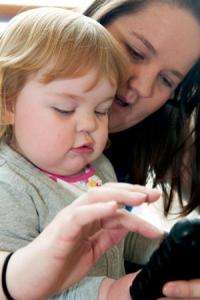
Retinoblastoma patient Savannah Smith and her mother, Courtney, before a recent appointment with J. William Harbour, M.D., at the Center for Advanced Medicine. Savannah had a radioactive plaque implanted Feb. 26 at St. Louis Children's Hospital. Credit: Robert Boston Washington University School of Medicine
An ophthalmologist at Washington University School of Medicine in St. Louis is implanting radioactive discs in the eyes of children with a rare cancer in an attempt to save their vision and their eyes.
J. William Harbour, MD, is one of only a few doctors nationwide to use the approach for treating a rare, childhood eye cancer, called retinoblastoma. Harbour, the Paul A. Cibis Distinguished Professor of Ophthalmology and Visual Sciences, performs the surgery at St. Louis Children's Hospital. He implants a small disc, or plaque, which stays in the eye for three days before a second surgery to remove it.
"The standard of care for retinoblastoma is chemotherapy, followed by laser and freezing treatments to eliminate the last remnants of tumors," Harbour says. "But occasionally there will be a tumor that doesn't respond to chemotherapy or is too large to treat with a laser or freezing treatment. That's where this plaque treatment comes in. It gives us an option that may allow us to save the eyes of a young child."
Retinoblastoma, as the name suggests, is characterized by tumors in the eye's retina. It is extremely rare, affecting about one child in 20,000. In the United States, about 200 children each year are diagnosed with retinoblastoma. Approximately 40 percent of them develop tumors in both eyes, so in cases where the tumors prove resistant to chemotherapy, very young children and their parents are faced with a choice between a life without eyes and a high risk of death.
This video is not supported by your browser at this time.
An ophthalmologist at Washington University School of Medicine in St. Louis is implanting radioactive discs in the eyes of children with a rare cancer in an attempt to save their vision and their eyes. One of only a few doctors in the nation using this approach, J. William Harbour, MD, is treating a rare childhood cancer, called retinoblastoma, which is characterized by tumors in the eye's retina. In the United States, about 200 children each year are diagnosed with the disorder. Harbour, the director of ocular oncology at the Siteman Cancer Center at Barnes-Jewish Hospital and Washington University School of Medicine, has recently started using the method to treat the cancer and possibly save the eyes. Credit: Washington University in St. Louis
That's why Harbour, also a professor of cell biology and of molecular oncology and director of ocular oncology at the Siteman Cancer Center at Barnes-Jewish Hospital and Washington University School of Medicine, and a handful of other eye cancer specialists have recently started using the plaque method to treat the cancer and possibly save the eyes."The treatment plaque looks like a bottle cap made of gold," Harbour says. "Radiation seeds are placed on one side of the plaque, shining the radiation in one direction like a flashlight focused on the tumor. That prevents the radiation from affecting other parts of the body."
The plaques contain seeds that deliver radiation directly to the tumor cells. Harbour says because the radiation gets to the tumor in a much more focused way than was possible in the past, it is not likely that these plaques will contribute to future problems in or around the eye.
Implantation of radioactive plaques has been relatively common in adult patients with a different eye cancer called ocular melanoma. The gold discs have been the standard of care for those patients for decades, and results to date in an ongoing National Institutes of Health (NIH) study have demonstrated that the plaques are an effective treatment in adults with ocular melanoma.
Although the NIH study showed that plaque therapy is as effective as eye removal in preventing the spread of ocular melanoma, the small number of children who have retinoblastoma make it unlikely a similar study could be conducted for that form of eye cancer. He estimates only about 10 to 20 children per year will require the plaque therapy in the United States.
This video is not supported by your browser at this time.
An ophthalmologist at Washington University School of Medicine in St. Louis is implanting radioactive discs into the eyes of children with a rare cancer in an attempt to save their vision and their eyes. The surgery involves a small disc, or plaque, which stays in the eye for three days before a second operation to remove it. Most kids with the form of cancer called retinoblastoma get chemotherapy, followed by laser and freezing treatments to eliminate the last remnants of tumors. But occasionally tumors don’t respond. Retinoblastoma is extremely rare. In the United States, about 200 children each year are diagnosed with the cancer, and approximately 40 percent develop tumors in both eyes. It’s important to have another option for those kids who don’t do well with chemotherapy because the only other treatment option is complete removal of the eye. Credit: Washington University BioMed Radio
Harbour says it takes several weeks to months to see the tumor start to melt away, but in both ocular melanoma and retinoblastoma, the plaques usually deal the cancer a fatal blow."The radiation causes damage within the cancer cells that prevents them from proliferating and spreading," he says. "By the time we take off the plaque, the cancer cells are either dead or mortally wounded, even though we do not immediately see a difference in the appearance of the tumor. After the plaque therapy, as the cancer cells try to proliferate and divide, those cells die, which we then notice in follow-up exams as the tumor shrinks over time."
Harbour still begins retinoblastoma treatment with chemotherapy, but when tumors are too big or unresponsive, the plaques provide a new option that has delivered positive results. Some children even can return to 20/20 vision depending on the size and location of the tumor, he says.
Provided by
Washington University School of Medicine
-
From lemons to lemonade: Reaction uses carbon dioxide to make carbon-based semiconductor,
32 comments
-
Thioridazine kills cancer stem cells in human while avoiding toxic side-effects of conventional cancer treatments,
3 comments
-
SpaceX private rocket blasts off for space station (Update),
42 comments
-
Climate scientists say they have solved riddle of rising sea,
31 comments
-
SpaceX capsule has 'new car' smell, astronauts say (Update),
4 comments
-
Potential Breakthrough in Seizure Control
May 26, 2012
-
Popping/Cracked sternum.
May 25, 2012
-
Which Mental Illness Encompasses This Problem?
May 25, 2012
-
A question about drug tolerance
May 23, 2012
-
Poor nutrition leading to overeating?
May 23, 2012
-
Math and dyslexia?
May 21, 2012
- More from Physics Forums - Medical Sciences
More news stories
T cells 'hunt' parasites like animal predators seek prey, study shows
By pairing an intimate knowledge of immune-system function with a deep understanding of statistical physics, a cross-disciplinary team at the University of Pennsylvania has arrived at a surprising finding: T cells use a movement ...
Medicine & Health / Medical research
10 hours ago |
5 / 5 (3) |
0
|
Same gene that stunts infants' growth also makes them grow too big: research
UCLA geneticists have identified the mutation responsible for IMAGe* syndrome, a rare disorder that stunts infants' growth. The twist? The mutation occurs on the same gene that causes Beckwith-Wiedemann syndrome, which makes ...
10 hours ago |
not rated yet |
0
|
Almost half of new vets seek disability
(AP) -- America's newest veterans are filing for disability benefits at a historic rate, claiming to be the most medically and mentally troubled generation of former troops the nation has ever seen.
8 hours ago |
not rated yet |
0
Color-changing contact lenses to help diabetics (w/ Video)
For the millions of Americans with diabetes, the inconvenient and often painful method of testing blood sugar levels is a way of life. But research and innovative product design by scientists at The University of Akron may ...
May 23, 2012 |
4.4 / 5 (7) |
5
|
Missouri opts for untested drug for executions
(AP) -- The same anesthetic that caused the overdose death of pop star Michael Jackson is now the drug of choice for executions in Missouri, causing a stir among critics who question how the state can guarantee ...
Medicine & Health / Medications
May 24, 2012 |
not rated yet |
5
'Unzipped' carbon nanotubes could help energize fuel cells, batteries
Multi-walled carbon nanotubes riddled with defects and impurities on the outside could replace some of the expensive platinum catalysts used in fuel cells and metal-air batteries, according to scientists at ...
Change in developmental timing was crucial in the evolutionary shift from dinosaurs to birds: study
At first glance, it's hard to see how a common house sparrow and a Tyrannosaurus Rex might have anything in common. After all, one is a bird that weighs less than an ounce, and the other is a dinosaur that ...
Computer model used to pinpoint prime materials for efficient carbon capture
When power plants begin capturing their carbon emissions to reduce greenhouse gases and to most in the electric power industry, it's a question of when, not if it will be an expensive undertaking.
Stunning image of smallest possible five-ringed structure
Scientists have created and imaged the smallest possible five-ringed structure about 100,000 times thinner than a human hair and you'll probably recognise its shape.
Land and sea species differ in climate change response: study
(Phys.org) -- Marine and terrestrial species will likely differ in their responses to climate warming, new research by Simon Fraser University and Australia’s University of Tasmania has found.
Yale study concludes public apathy over climate change unrelated to science literacy
Are members of the public divided about climate change because they don't understand the science behind it? If Americans knew more basic science and were more proficient in technical reasoning, would public consensus match ...