Printed cells to treat burn victims

Apr 12, 2010 by Lin Edwards report
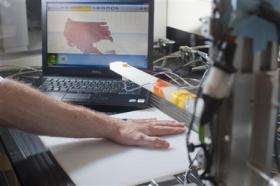
A device used to bioprint skin onto burns demonstration. Image credit: Wake Forest Institute of Regenerative Medicine/Handout

(PhysOrg.com) -- A medical device that works rather like an inkjet printer is being developed in the US to heal burns and other wounds by "printing" skin cells directly onto the wound. The device, called a bioprinter, may reduce the need for skin grafts. It would be mounted on a wheeled frame and positioned over the bed of the patient.

A laser inside the bioprinter, which was developed at Wake Forest University School of Medicine in Winston-Salem, North Carolina, first measures the size and shape of the wound and then applies specific precisely where they are needed. The skin cell spray is produced by dissolving from pieces of skin and then separating cell types such as keratinocytes and fibroblasts. The purified cells are then incubated in a nutrient solution where they multiply. They are then placed into sterilized cartridges and sprayed onto the wound by a similar process to a multi-color , with the fibroblasts sprayed on first followed by a layer of keratinocytes. The sprayed-on cells form a protective shield for the wound.

The device has so far only been tested on mice, but the initial results show wounds heal quickly and safely, with wounds healing three weeks faster than those that were untreated. Professor of regenerative medicine at the University, George Christ, said the group would next test the device on pigs, who have skin resembling human skin. They will eventually apply for approval from the US to allow them to carry out human trials. The team is also liaising with the US Armed Forces Institute of Regenerative Medicine with the aim of producing a device that could be used to treat wounded soldiers in Afghanistan and Iraq.

Victims of severe burns can die of infection within a couple of weeks unless if they do not receive , but the grafts can leave serious scarring. In the bioprinter the skin cells became integrated in the surrounding skin, which the researchers said was probably because the sprayed cells included immature stem cells. Student Kyle Binder, who helped design the device said when the cells were put into the wound, they “know what to do”.

Explore further: Study suggests new source of kidneys for transplant

Related Stories

Study uses bone marrow stem cells to regenerate skin

Jan 14, 2009

A new study suggests that adult bone marrow stem cells can be used in the construction of artificial skin. The findings mark an advancement in wound healing and may be used to pioneer a method of organ reconstruction. The ...

Clinical trials of spray-on skin to start in US

Nov 24, 2009

(PhysOrg.com) -- Clinical trials comparing a spray-on skin product with skin grafts will start in the US in December. The trials, which are partly funded by a US army grant of $1.4 million, will last about a year and will ...

Artificial skin system can heal wounds

Dec 20, 2007

A new study in Artificial Organs tested the effects of a wound dressing created with hair follicular cells. The findings reveal that skin substitutes using living hair cells can increase wound healing.

Skin care: new research into scar-free healing

Jan 21, 2008

New research from the University of Bristol shows that by suppressing one of the genes that normally switches on in wound cells, wounds can heal faster and reduce scarring. This has major implications not ...

From managing sugar to managing healing

Dec 10, 2006

Insulin is a hormone known primarily for regulating sugar levels in the blood, yet researchers at the University of California, Riverside, recently found that applying insulin directly to skin wounds significantly enhanced ...

Recommended for you

H. pylori, smoking trends, and gastric cancer in US men

4 hours ago

Trends in Helicobacter pylori (H. pylori) and smoking explain a significant proportion of the decline of intestinal-type noncardia gastric adenocarcinoma (NCGA) incidence in US men between 1978 and 2008, and are estimated ...

Common food supplement fights degenerative brain disorders

9 hours ago

Widely available in pharmacies and health stores, phosphatidylserine is a natural food supplement produced from beef, oysters, and soy. Proven to improve cognition and slow memory loss, it's a popular treatment for older ...

Finding a family for a pair of orphan receptors in the brain

10 hours ago

Researchers at Emory University have identified a protein that stimulates a pair of "orphan receptors" found in the brain, solving a long-standing biological puzzle and possibly leading to future treatments for neurological ...

Insight into the dazzling impact of insulin in cells

10 hours ago

Australian scientists have charted the path of insulin action in cells in precise detail like never before. This provides a comprehensive blueprint for understanding what goes wrong in diabetes.

Do men's and women's hearts burn fuel differently?

13 hours ago

Researchers at the University of Illinois at Chicago College of Medicine will study gender differences in how the heart uses and stores fat—its main energy source—and how changes in fat metabolism play ...

Study suggests new source of kidneys for transplant

May 20, 2013

Nearly 20 percent of kidneys that are recovered from deceased donors in the U.S. are refused for transplant due to factors ranging from scarring in small blood vessels of the kidney's filtering units to the organ going too ...

User comments : 0

More news stories

If you can remember it, you can remember it wrong

(Medical Xpress)—Native peoples in regions where cameras are uncommon sometimes react with caution when their picture is taken. The fear that something must have been stolen from them to create the photo ...

B vitamins could delay dementia

(Medical Xpress)—Despite spending billions of dollars on research and development, drug companies have been unable to come up with effective treatments for dementia and Alzheimer's Disease (AD). Now, A. ...

Reducing caloric intake delays nerve cell loss

Activating an enzyme known to play a role in the anti-aging benefits of calorie restriction delays the loss of brain cells and preserves cognitive function in mice, according to a study published in the May ...

New sleeping pill poised to hit US markets

An experimental sleeping pill from US drug company Merck is effective at helping people fall and stay asleep, according to reviewers at the US Food and Drug Administration, which could soon approve the new drug.

Changing cancer's environment to halt its spread

By studying the roles two proteins, thrombospondin-1 and prosaposin, play in discouraging cancer metastasis, a trans-Atlantic research team has identified a five-amino acid fragment of prosaposin that significantly reduces ...

New method for producing clean hydrogen

Duke University engineers have developed a novel method for producing clean hydrogen, which could prove essential to weaning society off of fossil fuels and their environmental implications.