Skin transplant offers new hope to vitiligo patients
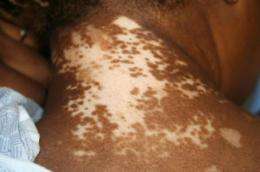
In the first study of its kind in the United States, Henry Ford Hospital showed that skin transplant surgery is safe and effective for treating vitiligo.
Henry Ford researchers followed 23 patients for up to six months after surgery and found that the treated area regained on average 52 percent of its natural skin color. In eight patients with a specific type of vitiligo, the treated area regained on average 74 percent of its natural skin color.
The surgery involves using skin cells taken from normally-pigmented areas of the body and transferring them to the damaged area of skin. It is performed under local anesthesia.
"This surgery offers hope to vitiligo patients," says Iltefat Hamzavi, M.D. a senior staff physician in Henry Ford's Department of Dermatology and the study's senior author and principal investigator. "The results achieved in our study were of obvious significance to our patients."
The study will be presented Tuesday, March 9 at the 68th annual American Academy of Dermatology meeting in Miami.
While the initial results are preliminary and the procedure is still investigational, Dr. Hamzavi says Henry Ford hopes to offer the surgery as part of its treatment portfolio this fall. He says for some patients the surgery is more effective than standard treatments like light therapy and topical medications.
"Patients of color and those with vitiligo on one side of the body and in one area of the body may benefit most from this procedure," Dr. Hamzavi says.
Vitiligo is a skin disease that causes the skin to lose color and develop white patches that vary in size and location. It affects about 1 in every 200 people in the United States, and is more noticeable in people with darker skin.
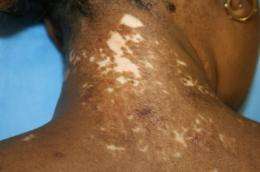
Vitiligo develops when cells called melanocytes are killed by the body's immune system, causing the area of skin to turn white because the cells no longer make pigment. While there is no cure, vitiligo can be treated and managed with light therapy, creams and topical medications.
The surgery is known as melanocyte-keratinocyte transplantation or MKTP, and is performed in Europe, Asia and Middle East. It was performed at Henry Ford using the same technique developed by MKTP pioneer Sanjeev Mulekar, M.D., of the National Vitiligo Center in Saudi Arabia. Henry Ford is the first to perform MKTP in North America.
In Henry Ford's study, 32 patients (18 male, 14 female) underwent surgery and ranged in age from 18 to 60. A total of 40 MKTP procedures were performed and researchers analyzed the outcomes of 29 of them. A procedure lasted 30 minutes to two hours and patients returned home the same day.
Of the 32 surgery patients, 23 were followed for up to six months after surgery. Eighteen patients received one treatment, four patients received two and one patient received three. The ethnicity of patients was Caucasian, South Asian, African American and Hispanic.
During MKTP, melanocyte cells, which produce pigment in the skin, hair and eyes, are harvested from an area of healthy skin and separated to make a skin cell mixture. This mixture then is applied to the treatment area and covered with a specially developed adhesive biologic dressing.
Treated areas included the hands, arms, legs, feet, face and stomach. The average size of the treated area during each procedure covered an area of 46 cm2, or roughly the size of a credit card.


