First evidence that the brain’s native dendritic cells can muster an immune response
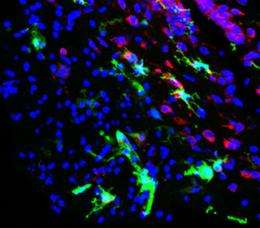
(PhysOrg.com) -- Since their initial discovery in 1973, dendritic cells, the sentinels of the immune system, have turned up in a number of places other than the immune organs. They stand guard in the heart, for instance, and in 2008, the first population native to the brain was identified. New research shows that dendritic cells are not only present in the brain, but active, too. They confront foreign substances and seem to form a barrier between healthy and stricken brain tissue following a stroke.
The human brain is a delicate organ, robustly defended. A thick skull shields it from any direct exposure to the outside world, and the blood-brain barrier keeps out any foreign substances that are circulating within. New research shows that the brain may have its own specialized immune defenses, too.
In 2008, researchers at Rockefeller University first identified a population of dendritic cells, the sentinels of the immune system, that was native to the brain. Now they have shown that these cells are not likely sleeping on the job. In experiments published recently in Proceedings of the National Academy of Sciences and Brain Behavior and Immunity, the researchers show that these brain dendritic cells can muster the immune system’s soldier T cells when confronted by certain threats. They also show that, unlike dendritic cells from elsewhere in the body, brain dendritic cells line up along the periphery of stroke-damaged brain tissue, perhaps as a barricade protecting the healthy cells outside.
“We knew they were there and now we know they are immunologically functional,” says Karen Bulloch, director of Rockefeller’s Neuroimmunology and Inflammation Program, which was funded by the Peter Deane Trust following the initial discovery of brain dendritic cells. Bulloch is a research associate professor who works with Bruce S. McEwen’s Harold and Margaret Milliken Hatch Laboratory of Neuroendocrinology and the Laboratory of Cellular Physiology and Immunology headed by Ralph M. Steinman, who discovered dendritic cells in 1973.
Dendritic cells capture and process foreign substances called antigens before presenting them to T cells, which multiply and attack the invaders. To test their activity in the brain, the researchers, led by Rockefeller graduate Andres Gottfried-Blackmore, now a student at Weill Cornell Medical College, injected a mouse brain with interferon-γ, an immune-response molecule produced during specific inflammatory responses. They found that the interferon increased the number of brain dendritic cells without recruiting dendritic cells from elsewhere in the immune system. They then exposed the dendritic cells to a model antigen called OVA, prompting a proliferation of OVA-specific T cells. The brain dendritic cells also proved far more effective at stimulating T cell proliferation in the same test than similar immune-related cells called microglia, which reside in the brain in huge numbers. The difference suggests a specialized role for brain dendritic cells.
In other experiments, led by postdoctoral fellow Jennifer Felger and in collaboration with the laboratory of Costatino Iadecola at Weill Cornell, researchers studied the response of brain dendritic cells labeled with a fluorescent protein after inducing strokes in mice. Unlike dendritic cells from elsewhere in the body, which were drawn into the stroke-damaged tissues, brain dendritic cells closed ranks around the perimeter of the damage, forming a barrier between stricken and healthy tissues.
Brain dendritic cells remain largely mysterious, but their immune-related activity suggests they play an important part in protecting the brain. The researchers are also interested in finding out what they do when they are not battling threats such as strokes or infections. “It is equally important to understand what they do when they are not defending the brain,” Bulloch says.
More information:
-- Proceedings of the National Academy of Sciences 106, 20918-20923 (December 8, 2009). Acute in vivo exposure to interferon-γ enables resident brain dendritic cells to become effective antigen presenting cells, Andres Gottfried-Blackmore, Ulrike W. Kaunzner, Juliana Idoyaga, Judit C. Felger, Bruce S. McEwen and Karen Bulloch
-- Brain, Behavior and Immunity online: November 13, 2009. Brain dendritic cells in ischemic stroke: Time course, activation state, and origin. Jennifer C. Felger, Takato Abe, Ulrike W. Kaunzner, Andres Gottfried-Blackmore, Judit Gal-Toth, Bruce S. McEwen, Costantino Iadecola and Karen Bulloch


