Epilepsy Patients Are Given New Hope With Brain Implant
Dec 09, 2009 by John Messina weblog
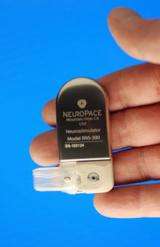
The device can detect abnormal electrical activity that precedes a seizure, and respond with a specific pattern of electrical jolts. Credit: Neuropace

(PhysOrg.com) -- A startup company, Neuropace in Mountain View Ca., has developed a device that offers new hope for epilepsy patients. The device is designed to neutralize the abnormal electrical activity in the region of the brain that causes seizures.

About 30 to 50 percent of epilepsy patients have trouble controlling their seizures with medication. This represents hundreds of thousands of patients in the U.S. alone.

A clinical trial was conducted on approximately 200 epilepsy patients who failed to respond to medication. The device was able to reduce the seizure frequency by 29 percent. This equates to approximately 100 patients seeing a 50 percent or greater reduction in seizure frequency.

The device is implanted into a hallowed out part of the skull and is approximately the size of a small deck of cards. Wires are placed on the surface of the brain or in the , depending where the seizures originate from. Prior to surgery, brain imaging, EEG () or ECoG (electrocorticography) is used to record in order to determine the area of the brain the originate from.

A study has shown that the procedure and device are relatively safe. A few patients have suffered from infections or bleeding which are consistently lower with similar procedures. A major benefit is that patients don't suffer from drug side effects that are common with many medications.

Once the device has been implanted, the patients need to go through optimization period where the doctor needs to program the device to recognize a seizure pattern and provide a particular pattern of electrical impulse that counter acts the electrical pattern of the seizure.

A patient waves a wand over her head to download data recorded by the Neuropace device before and after stimulation. (Credit: Neuropace)

Patients also need to learn to how to wave a wand over their head, where the implant is located, and download data recorded before and after brain stimulation. This data provides doctors with information to see how well the device is working and make any necessary adjustments.

Neurosurgeons are confident of the device's potential in determining the onset of a seizure and providing the necessary electrical impulse pattern to counter act the seizure. With time, patients and doctors will understand the effectiveness of the device and harness its full potential.

Additional information: Neuropace

Via: Technology Review
© 2009 PhysOrg.com

Explore further: New neuron formation could increase capacity for new learning, at the expense of old memories

add to favorites email to friend print save as pdf

Related Stories

Epilepsy breakthrough on horizon

Aug 31, 2006

Researchers at MIT are developing a device that could detect and prevent epileptic seizures before they become debilitating.

Recommended for you

Help at hand for people with schizophrenia

May 24, 2013

How can healthy people who hear voices help schizophrenics? Finding the answer for this is at the centre of research conducted at the University of Bergen.

Controlling mood through the motions of mitochondria

May 23, 2013

(Medical Xpress)—Regulating the distribution of power in neurons is done by a system that makes the national electric grid look simple by comparison. Each neuron has several thousand mitochondria confined ...

Depression common among children with temporal lobe epilepsy

May 23, 2013

A new study determined that children and adolescents with seizures involving the temporal lobe are likely to have clinically significant behavioral problems and psychiatric illness, especially depression. Findings published ...

User comments : 2

Adjust slider to filter visible comments by rank

Display comments: newest first

Simonsez
not rated yet Dec 09, 2009
I am surprised that something as large as what is depicted in the image does not itself cause seizures (or other brain "discomfort")! I would think potential receivers of this implant would wait until the technology has been made a bit smaller... having them make a "hallowed out part of the skull" sounds terribly unnecessary.
Mr_Frontier
not rated yet Dec 09, 2009
Beats getting a seizure crossing a side walk, on a flight of stairs, or driving a car, etc. Whose brain might be hallowed out more, statistically? The one in the car-turned-swerving-ballistic, or the one with the reduced chance of symptoms with a fine-tunable implant? When someone is desperate enough for a try at a normal life, waited long enough, and suffered long enough, some additional risks and modifications are irrelevant.

More news stories

Heart failure accelerates male 'menopause'

Heart failure accelerates the aging process and brings on early andropausal syndrome (AS), according to research presented today at the Heart Failure Congress 2013. AS, also referred to as male 'menopause', was four times ...

Feds fight morning-after pill age ruling in NY

(AP)—Department of Justice lawyers have again asked a federal appeals court in New York to delay lifting age restrictions and prescription requirements on an emergency contraceptive popularly known as the morning-after ...