Medical interpreters break language barriers in health care
Sep 17, 2009
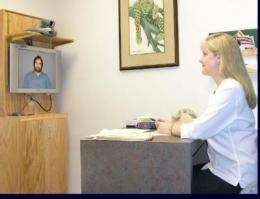
Karen Edison, director of the MU Center for Health Policy, talks with a patient via videoconferencing technology from the Missouri Telehealth Network. The technology is part of a grant-funded project that provides medical interpreters for patients. Credit: MU Center for Health Policy

Language barriers in health care settings can decrease access to quality care and diminish comprehension for limited English proficient patients (LEP). These barriers compromise quality of care, and increase costs and inefficiencies. Now, the University of Missouri Institute of Public Policy, Center for Health Policy and Missouri Telehealth Network are partnering with the Language Access Metro Project (LAMP) and the Missouri Primary Care Association to provide medical interpreters to non-English-speaking patients who otherwise might not have access to live interpreters.

"The program will demonstrate the advantages of utilizing professionally trained medical interpreters for LEP patients, including improving patient communication by eliminating language and cultural barriers," said Dana Hughes, policy analyst in the Truman School of Public Affairs. "Interpreters also help health care providers decrease costs and eliminate misdiagnoses and unnecessary testing."

The Missouri Telehealth Interpretation Project will provide LAMP interpreters, free of charge for two years, to health care providers through the Missouri Telehealth Network (MTN), already in place throughout the state. MTN uses two-way live, interactive video to deliver patient care from providers in urban areas to underserved patients throughout the state in specialties such as dermatology, psychiatry, autism, endocrinology and others. LAMP interpreters will attend patient appointments and confirm appointments to reduce patient no-shows and late cancellations.

"By having access to interpreters, health care providers will be able to give linguistically and culturally competent care to their LEP patients," said Nikki Lopresti, director of LAMP. "As word spreads, more LEP patients will gain access to improved quality ."

Resources for professionally trained medical interpreters in Missouri are limited, especially in rural areas. Availability, scheduling, and quality of interpreters are issues for many primary care clinics.

The project is funded by a grant from the Missouri Foundation for Health. After the initial two-year, grant-funded period ends, continued use of medically trained interpreters will benefit LEP patients, sustain the telehealth network and increase utilization of LAMP interpreters.

Source: University of Missouri-Columbia (news : web)

Explore further: Aid group urges Spain to scrap 'dangerous' healthcare reform

add to favorites email to friend print save as pdf

Related Stories

Doctor: Patients need interpreters

Jul 21, 2006

A new study finds that millions of U.S. residents with limited English skills are at risk when they go to a hospital or a doctor's office.

Sign language interpreters at high ergonomic risk

Apr 17, 2008

Sign language interpreting is one of the highest-risk professions for ergonomic injury, according to a new study conducted by Rochester Institute of Technology. The research indicates that interpreting causes more physical ...

Recommended for you

EHR implementation first step toward quality improvement

14 hours ago

(HealthDay)—Implementation of electronic health records (EHRs) is a first step toward quality improvement and should be accompanied by use of new payment models to allow physicians to see a return on their ...

Why are some college students more likely to 'hook up'?

15 hours ago

Casual, no-strings sexual encounters are increasingly common on college campuses, but are some students more likely than others to "hook up"? A new study by researchers with The Miriam Hospital's Centers for Behavioral and ...

User comments : 0

More news stories

Panic over MERS virus fades in Saudi

People in Saudi Arabia's Eastern Province have again started greeting friends with the traditional kiss on the cheek, and face masks in public are becoming rarer, as panic subsides over the outbreak of a deadly respiratory ...

French firemen test hypnosis to help victims

"Look me straight in the eye. Your mind is emptying, your body is relaxing," says the fireman, using the calming words of hypnosis to help a trauma victim—a technique being pioneered by fire crews in the eastern French ...

S.Korean airlines ban shark fin as cargo

South Korea's two largest airlines, Korean Air and Asiana, said Thursday they had both decided to ban shark fin from their cargo flights as part of a growing global campaign against the Asian delicacy.

AP buys stake in live video service Bambuser

The Associated Press said Thursday that it has bought a minority stake in the live video service Bambuser, boosting its ability to acquire and distribute video collected by people who have witnessed news events.

UNESCO warns Syrian heritage sites endangered

UNESCO on Thursday added six ancient sites in Syria including a fortress of Saladin and a Crusader castle to the endangered World Heritage list, warning that more than two years of civil war had inflicted ...

Philippines financial capital bans plastic bags

The Philippines financial capital banned disposable plastic shopping bags and styrofoam food containers on Thursday, as part of escalating efforts across the nation's capital to curb rubbish that exacerbates ...