New insights into how SARS pathogen infects host
Apr 14, 2009 By Krishna Ramanujan
New insights into how SARS pathogen infects host
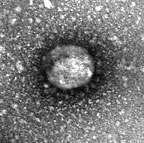
Infectious bronchitis virus. (Victor Chu)

(PhysOrg.com) -- When Severe Acute Respiratory Syndrome (SARS) first appeared in 2003, international cooperation helped contain the virulent coronavirus, which caused respiratory illness in more than 8,000 people and killed almost 10 percent of them. Better understanding of such viruses will help control similar diseases when they strike again.

Now, Cornell researchers have discovered key properties in coronaviruses that help explain how these viruses invade their hosts and cross species barriers. The SARS virus, for example, originated in bats, jumped to civets (weasel-like mammals) in Chinese markets and then to humans. Other coronaviruses cause the common cold and croup in humans.

The researchers have discovered two sites -- called cleavage sites -- where a key structural protein on the virus gets split, activating a process that allows the virus to enter a host cell. They report their findings online in the . One cleavage site was known to exist, but studies of a mutated vaccine strain of another highly virulent avian coronavirus, known as infectious bronchitis virus (IBV), revealed a second cleavage site. This discovery led Cornell researchers to search for a second cleavage site in the SARS virus, which they found in exactly the same location as in IBV.

Viruses often access cells by binding to receptors on the cell's surface, but unfamiliar receptors provide barriers. However, small changes in the second cleavage site may allow coronaviruses to bypass receptors and gain entry into many cells, including those of new species. The findings provide researchers with a new context to identify virulent disease strains and could possibly lead to developing treatments.

"We can now make predictions based on cleavage sites about new viruses that might come about," said Gary Whittaker, associate professor of virology at Cornell's College of Veterinary Medicine and the paper's senior author. "SARS appeared and then went away, but it is only a matter of time before similar viruses make that leap [to spread and jump species]."

While changes in the first cleavage site can affect a virus's ability to infect, the study reports that changes in the second site are always necessary for increased virulence. Whittaker believes that coronaviruses may have begun with just one cleavage site but then evolved the second one.

The researchers also report that their findings have led to new insights into such animal coronaviruses as feline infectious peritonitis (FIP), the most infectious disease in cats and the feline equivalent of SARS. As expected, the FIP virus's ability to infect cells is dictated by the same two cleavage sites, and studying FIP may contribute insights into SARS, since cats are vectors in both diseases. During the 2003 SARS outbreak, cats in a Hong Kong hotel helped transmit the disease between humans.

Provided by Cornell University (news : web)

Explore further: Do men's and women's hearts burn fuel differently?

add to favorites email to friend print save as pdf

Related Stories

Evolutionary History of SARS Supports Bats As Virus Source

Feb 19, 2008

Scientists who have studied the genome of the virus that caused severe acute respiratory syndrome (SARS) say their comparisons to related viruses offer new evidence that the virus infecting humans originated in bats.

Scientists’ studies combat health threats

May 25, 2007

The outbreak of severe acute respiratory syndrome (SARS) in 2002 was a loud wake-up call for researchers studying infectious diseases. SARS infected more than 8,000 people, killed 10 percent of those infected and weakened ...

Scientists determine how SARS kills

Jul 14, 2005

Scientists reportedly have developed a therapy to decrease the extraordinarily high death rate associated with the SARS virus.

Recommended for you

Targeting the X-factor to tackle cardiovascular disease

42 minutes ago

New research at The University of Nottingham aimed at preventing harmful blood clots associated with heart disease and stroke has recently received a major funding boost from the British Heart Foundation.

Italy approves law on controversial stem cell therapy

56 minutes ago

Italian lawmakers on Wednesday gave their final approval to a law that allows limited use of a controversial type of stem cell therapy which has been condemned by many scientists but has given hope to families of terminally-ill ...

H. pylori, smoking trends, and gastric cancer in US men

15 hours ago

Trends in Helicobacter pylori (H. pylori) and smoking explain a significant proportion of the decline of intestinal-type noncardia gastric adenocarcinoma (NCGA) incidence in US men between 1978 and 2008, and are estimated ...

Common food supplement fights degenerative brain disorders

19 hours ago

Widely available in pharmacies and health stores, phosphatidylserine is a natural food supplement produced from beef, oysters, and soy. Proven to improve cognition and slow memory loss, it's a popular treatment for older ...

Finding a family for a pair of orphan receptors in the brain

20 hours ago

Researchers at Emory University have identified a protein that stimulates a pair of "orphan receptors" found in the brain, solving a long-standing biological puzzle and possibly leading to future treatments for neurological ...

User comments : 0

More news stories

Italy approves law on controversial stem cell therapy

Italian lawmakers on Wednesday gave their final approval to a law that allows limited use of a controversial type of stem cell therapy which has been condemned by many scientists but has given hope to families of terminally-ill ...

Ethicists' behavior not more moral, study finds

(Medical Xpress)—Do ethicists engage in better moral behavior than other professors? The answer is no. Nor are they more likely than nonethicists to act according to values they espouse, according to researchers from the ...

Coral reefs 'ruled by earthquakes and volcanoes'

(Phys.org) —Titanic forces in the Earth's crust explain why the abundance and richness of corals varies dramatically across the vast expanse of the Indian and Pacific Oceans, a world-first study from the ...

Coccoliths thrive despite ocean acidification

Ocean acidification is damaging some marine species while others thrive, say scientists. An international team studied the effect of ocean acidification on plankton in the North Sea over the past forty years, ...