Mice and men should have more in common in clinical trials
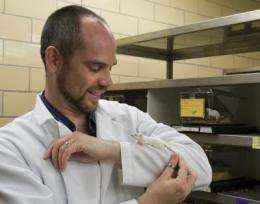
Just as no two humans are the same, a Purdue University scientist has shown treating mice more as individuals in laboratory testing cuts down on erroneous results and could significantly reduce the cost of drug development.
Mice have long been used as test subjects for treatments and drugs before those products are approved for human testing. But new research shows that the customary practice of standardizing mice by trying to limit environmental variation in laboratories actually increases the chance of getting an incorrect result.
The study, done by Joseph Garner, a Purdue assistant professor of animal sciences, and professor Hanno Würbel of the Justus-Liebig University of Giessen in Germany, was published in the early online edition of Nature Methods on Monday (March 30). It suggests scientists should change their methods and test mice in deliberately varying environmental conditions. Garner said that will decrease the number of false positive test results and eliminate further costly testing of drugs or treatments destined to fail.
"In lab animals, we have this bizarre idea that we can control everything that happens," Garner said. "But we would never be able to do that with humans, and we wouldn't want to. You want to know if a drug is going to work in all people, so you test it on a wide range of different people. We should do the same thing with mice."
Garner said human testing uses a broad range of subjects, giving scientists an idea of how a drug or treatment might affect different types of people. But scientists often use mice that are basically genetically identical and try to limit internal and external environmental factors such as stress, diet and age to eliminate variables affecting the outcome.
Garner said there is no practical way to ensure that all environmental conditions are the same with mice, however, because they respond to cues humans cannot detect. For example, a researcher's odor in one lab might cause more stress for a mouse than another researcher's odor in a second lab with different mice, giving different results. But scientists, unaware of the odor difference, may believe a treatment worked when the mice were actually responding to an environmental cue, giving a false positive.
The study used three different strains of mice from previously published data and compared their behavioral characteristics against each other. The observations were done in three different labs, two different types of cages and at three different times to make 18 different replicates of the same experiment. Traditional testing theories say the results should have been the same in all those experiments.
Once the results were compared, however, the researchers found many false positives, or instances when one strain appeared to act differently from another when it actually should not.
"There were nearly 10 times more false positives than we would expect by chance," Garner said. "There had to be a gremlin causing these false positives."
The researchers suspected the problem was in the traditional lab experiment design. So they reevaluated the data, picking a mouse of each strain from each environment - similar to matching pairs in human clinical trials - and found only the same number of false positives as would be expected by chance.
When mouse testing creates a false positive, leading a researcher to believe a drug has worked, the drug could be sent to further animal testing and human clinical trials at a cost of millions of dollars. Drugs that fail in clinical trials cannot be marketed, and the money is wasted. To recoup those losses, drug companies must increase the costs of marketable drugs.
"Drugs aren't expensive because they're costly to make," Garner said. "They're expensive because the company has to recoup the costs of the other drugs that have failed in human clinical trials. Numbers are hard to estimate, but for every drug that reaches the marketplace, well over 100 have been abandoned at some point in their development."
Garner said giving mice varying environments also could be better for the animals because fewer could be used. Weeding out an unsuccessful drug would eliminate an unnecessary second round of animal testing.
"The really exciting message is that we have shown how the false positives in early drug discovery can be drastically reduced without costing anything more than a change in experimental design," Garner said. "These are positive results for pharmaceutical research, patients and for mice."
Source: Purdue University (news : web)


