Regions of the brain can rewire themselves
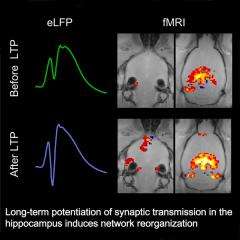
(PhysOrg.com) -- Scientists at the Max Planck Institute for Biological Cybernetics in Tübingen have succeeded in demonstrating for the first time that the activities of large parts of the brain can be altered in the long term.
The breakthrough was achieved through the experimental stimulation of nerve cells in the hippocampus. Using a combination of functional magnetic resonance tomography, microstimulation and electrophysiology, the scientists were able to trace how large populations of nerve cells in the forebrain reorganize. This area of the brain is active when we remember something or orient ourselves spatially. The insights gained here represent the first experimental proof that large parts of the brain change when learning processes take place. (Current Biology, March 10, 2009)
Scientists refer to the characteristic whereby synapses, nerve cells or entire areas of the brain change depending on their use as neuronal plasticity. It is a fundamental mechanism for learning and memory processes. The explanation of this phenomenon in neuronal networks with shared synapses reaches as far back as the postulate of Hebbian learning proposed by psychologist Donald Olding Hebb in 1949: when a nerve cell A permanently and repeatedly stimulates another nerve cell B, the synapse is altered in such a way that the signal transmission becomes more efficient. The membrane potential in the recipient neuron increases as a result. This learning process, whose duration can range from a few minutes to an entire lifetime, was intensively researched in the hippocampus.
A large number of studies have since shown that the hippocampus plays an important role in memory capacity and spatial orientation in animals and humans. Like the cortex, the hippocampus consists of millions of nerve cells that are linked via synapses. The nerve cells communicate with each other through so-called "action potentials": electrical impulses that are sent from the transmitter cells to the recipient cells. If these action potentials become more frequent, faster or better coordinated, the signal transmission between the cells may be strengthened, resulting in a process called long-term potentiatation (LTP), whereby the transmission of the signal is strengthened permanently. The mechanism behind this process is seen as the basis of learning.
Although the effects of long-term potentiation within the hippocampus have long been known, up to now it was unclear how synaptic changes in this structure can influence the activities of entire neuronal networks outside the hippocampus, for example cortical networks. The scientists working with Nikos Logothetis, Director at the Max Planck Institute for Biological Cybernetics, have researched this phenomenon systematically for the first time. What is special about their study is the way in which it combines different methods: while the MRI scanner provides images of the blood flow in the brain and, therefore, an indirect measure of the activity of large neuronal networks, electrodes in the brain measure the action potentials directly, and therefore the strength of the nerve conduction. It emerged from the experiments that the reinforcement of the stimulation transmission generated in this way was maintained following experimental stimulation.
"We succeeded in demonstrating long-term reorganization in nerve networks based on altered activity in the synapses," explains Dr. Santiago Canals. The changes were reflected in better communication between the brain hemispheres and the strengthening of networks in the limbic system and cortex. While the cortex is responsible for, among other things, sensory perception and movement, the limbic system processes emotions and is partly responsible for the emergence of instinctive behavior.
More information: Santiago Canals, Michael Beyerlein, Hellmut Merkle & Nikos K. Logothetis, Functional MRI Evidence for LTP-Induced Neural Network, Current Biology (2009), doi:10.1016/j.cub.2009.01.037
Provided by Max-Planck-Institute for Biological Cybernetics


