Brain protein may be a target for fast-acting antidepressants
(PhysOrg.com) -- It takes weeks or months for the effect of most antidepressants to kick in, time that can feel like an eternity to those who need the drugs the most. But new research suggests that a protein called p11, previously shown to play a role in a person’s susceptibility to depression, activates a serotonin receptor in the brain known for producing a rapid antidepressant response. If scientists could develop drugs to target this receptor, they might produce an effect in as little as two days.
The finding, reported this month in The Journal of Neuroscience by Rockefeller University’s Paul Greengard, Jennifer L. Warner-Schmidt and colleagues in Sweden, solidifies p11 as a key determinant of vulnerability to depression and may lead investigators to new treatments.
Previous research by Greengard, who is Vincent Astor Professor and head of the Laboratory of Molecular and Cellular Neuroscience, and coauthor Per Svenningsson established p11 as a key signaling molecule for a neurotransmitter known as serotonin, which has long been linked to mood. They also showed that the interaction between p11 and serotonin influences an individual’s susceptibility to depression and his or her response to antidepressant treatments. (They later showed that p11 and serotonin also play a role in the symptoms of advanced Parkinson’s disease.)
These earlier studies focused on the serotonin 1B receptor. For the new study, Greengard, Svenningsson and their colleagues looked at p11’s interaction with another receptor known as serotonin 4, which has been shown to produce a rapid antidepressant response in rodent models of depression. Because serotonin 4 is expressed outside the brain, particularly in the gastrointestinal system, scientists have had difficulty homing in on it to evaluate its potential as an effective therapeutic target.
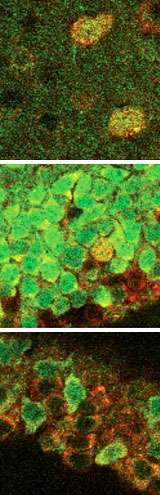
Using transgenic mice that express a green fluorescent protein when the serotonin 4 receptor is switched on, the researchers showed that p11 and serotonin 4 are expressed together in regions of the brain that are associated with depression.
Previous studies by Greengard’s team showed that p11 is required for the antidepressant actions of a molecule called an agonist, which activates the serotonin 1B receptor. To determine whether p11 is required for the action of a serotonin 4 agonist, the researchers injected two groups of mice with a compound called RS67333, which has been shown to produce antidepressant-like effects. They found that the antidepressant activity of RS67333 was normal in normal mice but absent in mice that were lacking p11.
“Together, these findings confirm the essential role played by p11 in modulating signaling through the serotonin 4 receptor and support the concept that this protein may be a key determinant of vulnerability to depression,” says Greengard.
Currently available antidepressants require weeks or months to produce therapeutic effects in patients. Studies in rodents have shown that behavioral responses that typically require two to three weeks of antidepressant treatment will occur after only one or two days of treatment with the serotonin 4 receptor agonist RS67333. The interaction of p11 with serotonin 4, says Greengard, represents a promising avenue of investigation for improved antidepressants.
“There is a pressing clinical need for faster-acting antidepressants,” says Greengard. “An understanding of the cellular mechanisms underlying the therapeutic actions of these drugs may lead to better treatments with fewer side effects.”
More information: The Journal of Neuroscience 29(6): 1937-1946 (February 11, 2009), Role of p11 in Cellular and Behavioral Effects of 5-HT4 Receptor Stimulation, Jennifer L. Warner-Schmidt, Marc Flajolet, Abigail Maller, Emily Y. Chen, Hongshi Qi, Per Svenningsson and Paul Greengard
Provided by Rockefeller University


