Mesh-like network of arteries adjusts to restore blood flow to stroke-injured brain
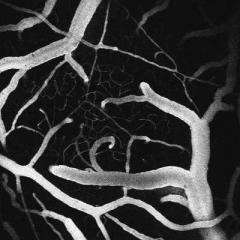
A grid of small arteries at the surface of the brain redirects flow and widens at critical points to restore blood supply to tissue starved of nutrients and oxygen following a stroke, a study published this week has found.
"This is optimistic news," said David Kleinfeld, a physics professor at the University of California, San Diego, whose group studies blood flow in animal models of stroke.
Damage from stroke can continue for hours or even days as compromised brain tissue surrounding the core injury succumbs to deprivation of oxygen and nutrients.
"This is the area doctors are trying to protect after a stroke," said Andy Shih, a postdoctoral fellow in Kleinfeld's group who conducted the experiments. "Those neurons are teetering on the edge of death and survival."
Previous work with animal models had found that blood flow can persistently slow in the aftermath of a stroke, which would hinder the delivery of drugs that might help recovery. But those studies only measured the speed of the blood.
By measuring both the speed of blood cells moving through individual small arteries and the diameters of the same vessels, the scientists found that the arteries dilate to maintain a constant delivery of blood cells.
"You find that the velocity has gone down, but that the diameter—on average—exactly compensates," Kleinfeld said.
Patrick Drew and Philbert Tsai in Kleinfeld's group, and Beth Friedman and Patrick Lyden, MD, of the neuroscience department at UC San Diego's School of Medicine co-authored the paper. Lyden, whose contributions to a 1995 study proved that the drug tPA can reverse the course of stroke when administered promptly, also directs the UC San Diego Stroke Center. The Journal of Cerebral Blood Flow and Metabolism published their new finding online January 28.
Key to this resilience, it seems, is the structure of the vascular network overlying the brain.
"Vessels on the surface of the brain have a mesh-like architecture," Kleinfeld said. "One consequence of that is that it operates like a grid system that redistributes "current flow as you need it."
"City traffic freezes a lot less than you would think because once a street gets bogged down, you can move over to another street," he said. "This seems to be what happens on the surface of the brain."
Flows through the surface vessels reversed and stalled, as previously observed, but those changes helped to redistribute blood to ensure a steady supply though vessels that penetrate into the brain.
Shih focused his measurements on small arteries, called arterioles, at the point where they dive into the brain to supply a discrete patch of the cortex, a juncture that is vulnerable to occlusions that can cause microstrokes this group's previous work has found.
"These are extremely important. A single penetrating arteriole will feed a column of tissue," Shih said. "These are bottlenecks in flow."
The penetrating vessels neither reversed nor stalled, even though many connected to loops and bridges in the vascular network that could have allowed that to happen. Even when the pressure dropped permanently as a result of stroke damage, wider lanes allowed the network to deliver red blood cells at the same rate.
"Diameter is the major determinant to how blood actually flows through vessels. Open up a blood vessel a little bit and you'll have a huge change in the amount of blood that goes through," Shih said. "Blood flow comes back, and it seems that these vessels are very resistant to the stroke. They function quite normally."
Source: University of California - San Diego


