New findings on immune system in amphibians
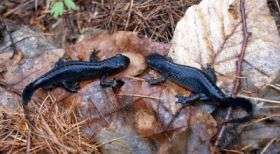
Major Histocompatibility Complex (MHC) genes produce proteins that are crucial in fighting pathogen assault. Researchers from the Jagiellonian University in Krakow and from the Helmholtz Centre for Environmental Research (UFZ) characterized genetic variation and detected more than one MHC class II locus in a tailed amphibian. Unlike mammals, not much has been known until now about the immune defence of amphibians. Globally, amphibian populations are in an unprecedented decline, to a considerable extent caused by rapidly spreading infectious diseases, such as the fungal infection Chytridiomycosis.
Therefore future conservation strategies for amphibians could benefit from knowledge about species-specific adaptations indicated by MHC variation, say the researchers writing in the journal Molecular Ecology. For their research, the scientists conducted a genetic study of various populations of the Alpine newt (Mesotriton alpestris) in Poland at the northern limit of this Central European species' distribution range. The Alpine newt is the first European and the third on the global scale, tailed amphibian species in which the MHC has been studied, and the first one in which more than one MHC II locus has been found.
The crucial role of the MHC in the immunity of mammals is well recognized. The discovery in tailed amphibians, however, shows that the genetic variation in MHC is important for this group as well: "In this study we were able to demonstrate that positive selection has been acting" reports Wies³aw Babik of the Jagiellonian University in Krakow. "This means that these genes play an important role in the immune system which recognises and fights diseases." The lead author of the study, Wies³aw Babik, conducted the research as part of a collaborative project between the University of Krakow and the UFZ in Halle/Saale that was financed by the Alexander von Humboldt Foundation. "Until now, scientists have assumed that the MHC in amphibians is not particularly important. But this is definitely not the case," explains Dr Walter Durka of the UFZ, who supervised Wies³aw Babik during his post-doctoral research.
In an earlier DNA study, the researchers were able to show that over the past 10,000 years the Polish populations of the Alpine newt on the northern boundary of its distribution range have achieved a high level of genetic diversity comparatively quickly. The three isolated populations in the Sudetes, Carpathian and Œwiêtokrzyskie Mountains probably evolved from a single refugium in which the newts survived the last Ice Age.
Alpine newts are primarily found in wooded hilly and mountainous areas of Central Europe up to altitudes of 2500 metres. There are also subspecies in Spain, Italy and on the Balkan peninsula. For reproduction, the species relies on small bodies of water, where the females lay their eggs after mating and where the newt larvae later develop. Following metamorphosis, the adult newts leave the water and overwinter under tree roots or stones. Alpine newts can live to an age of 20 years. A particular feature of the Alpine newt - the smallest native newt, measuring no more than 11 cm - is the number of its toes. Like all tailed amphibians, the back limbs usually have five toes, while the front limbs have four.
Source: Helmholtz Association of German Research Centres


