Antioxidant therapy shows early promise for preventing, perhaps reversing, Alzheimer's disease
Apr 30, 2008
Antioxidant therapy shows early promise for preventing, perhaps reversing, Alzheimer's disease
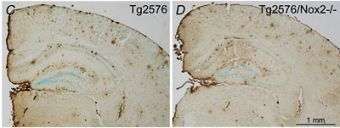
Amyloid plaques in the brain of the mice with Alzheimer's disease. The plaques are the brown spots distributed throughout the brain.

Curbing harmful processes in the brain's vasculature set off by the enzyme NADPH oxidase may reverse some of the cognitive decline associated with Alzheimer's disease, according to new findings published in a recent issue of the Proceedings of the National Academy of Sciences.

Identifying the enzyme's role in dementia could translate into a new drug target for Alzheimer's disease in humans.

Costantino Iadecola, the George C. Cotzias Distinguished Professor of Neurology and Neuroscience at Weill Cornell Medical College and chief of the Division of Neurobiology at NewYork-Presbyterian Hospital/Weill Cornell Medical Center, led the research, which found that after the enzyme was genetically "switched off," mice with a type of dementia mimicking Alzheimer's regained important cognitive abilities.

The amount of Alzheimer's-linked amyloid plaques in the brains of the mice remained unchanged, indicating that NADPH oxidase, which produce toxic free radicals, independently influences the progression of dementia.

The researchers also genetically engineered mice that produced a mutated form of NADPH enzyme that did not produce the toxic free radicals. The result: The formerly "demented" mice regained their healthy, exploratory behaviors, just as non-demented mice do. According to the authors, the findings suggest that neurological damage from Alzheimer's may not be permanent and might even be reversed through antioxidant treatment.

Source: Cornell University

Explore further: Mild hypothyroidism raises mortality risk among heart failure patients

add to favorites email to friend print save as pdf

Related Stories

Three-photon microscopy improves biological imaging

Jan 22, 2013

(Phys.org)—Scientists may be a step closer to cracking one of the world's most compelling mysteries: the impossible complexity of the brain and its billions of neurons. Cornell researchers have demonstrated ...

Rare white horse prancing around in his own special genes

Jun 01, 2012

There was no hanky-panky involved when a fairy-tale white foal was born to two brown Standardbreds at the Four Winds Farm in New Jersey. DNA tests confirm that the snowy foal, born May 6, is a mutant, but that's nothing to ...

More choline reduces Down syndrome dysfunction

Jun 02, 2010

(PhysOrg.com) -- In a mouse model of Down syndrome, pregnant and lactating mice that received additional choline had offspring that fared much better than those whose mothers did not receive choline, a new ...

Improved estrogen reception may sharpen fuzzy memory

Jul 29, 2008

Estrogen treatments may sharpen mental performance in women with certain medical conditions, but University of Florida researchers suggest that recharging a naturally occurring estrogen receptor in the brain may also clear ...

Paving the way toward a vaccine against Alzheimer's disease

Jun 21, 2007

Scientists have provided new details about how proteins used to destroy bacteria and viruses may help treat Alzheimer’s disease. Gunnar K. Gouras, associate professor of neurology and neuroscience at Weill Medical College ...

Recommended for you

Researchers suggest boosting body's natural flu killers

2 hours ago

A known difficulty in fighting influenza (flu) is the ability of the flu viruses to mutate and thus evade various medications that were previously found to be effective. Researchers at the Hebrew University of Jerusalem have ...

SARS-like virus claims new life in Saudi

21 hours ago

A man who had contracted the coronavirus has died in Saudi Arabia, raising the death toll in the kingdom from the SARS-like virus to 17, the health ministry announced on its website on Wednesday.

User comments : 0

More news stories

The secret lives, and deaths, of neurons

As the human body fine-tunes its neurological wiring, nerve cells often must fix a faulty connection by amputating an axon—the "business end" of the neuron that sends electrical impulses to tissues or other ...

A hidden population of exotic neutron stars

(Phys.org) —Magnetars – the dense remains of dead stars that erupt sporadically with bursts of high-energy radiation - are some of the most extreme objects known in the Universe. A major campaign using ...

White tiger mystery solved

White tigers today are only seen in zoos, but they belong in nature, say researchers reporting new evidence about what makes those tigers white. Their spectacular white coats are produced by a single change ...

Amazon expands Kindle tablet sale to 170 countries

Online retail titan Amazon announced Thursday it is expanding sales of its Kindle tablet computers to "over 170 countries and territories around the world," and its Appstore in nearly 200 countries.