First global malaria map in decades shows reduced risk
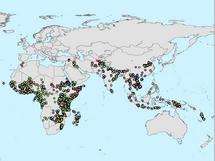
About 35 percent of the world’s population is at risk of contracting deadly malaria, but many people are at a lower risk than previously thought, raising hope that the disease could be seriously reduced or eliminated in parts of the world.
So concludes a group of researchers, including a scientist in the University of Florida Emerging Pathogens Institute, who spent three years producing the first spatial map of global malaria risk in four decades.
The Malaria Atlas Project’s findings appear today in the online edition of the open-access medical journal, PLoS Medicine.
The Malaria Atlas Project, or MAP, found that 2.37 billion people were at risk of contracting malaria from Plasmodium faciparum, the most deadly malaria parasite for humans transmitted through the bites of infected Anopheles mosquitoes. Of that number, about 1 billion people live under a much lower risk of infection than was assumed under the previous historical maps. The lower than expected risk extends across Central and South America, Asia and even parts of Africa, the continent where malaria kills the vast majority of its victims and where risk has historically been classified as universally high.
“This gives some hope of pursuing malaria elimination because the prevalence isn’t as universally high as many people suppose,” said David Smith, a UF associate professor of zoology and a co-author of the paper. “It’s reasonable to think we can reduce or interrupt transmission in many places, but the prospects for success will improve if we make plans that are based on good information about malaria’s distribution.”
The MAP effort, a collaboration between Oxford University and the Kenyan Medical Research Institute, compiled information from national health statistics, tourist travel advisories, climate, mosquito vectors and surveys of malaria infection in nearly 5,000 communities and 87 countries. The project also incorporated information about how climatic conditions affect mosquito life cycles, and thus the likelihood of active transmission.
“One of my contributions was to help standardize prevalence estimates,” Smith said.
The new map is important in part because it offers hope that malaria could be eliminated in certain areas using currently available tools, such as bed nets treated with insecticide that kills mosquitoes, the researchers said. It will also help donors and international agencies target investments in control measures where they are most likely to achieve the biggest gains.
More than 500 million cases of malaria are reported annually. Of those afflicted, about one million die; 80 percent of them are children in sub-Saharan Africa.
“Making data and maps more accessible on the worldwide web is a large part of the MAP’s philosophy of getting the science accessed, critiqued and used by a much wider range of users,” said the lead author of the paper, Carlos Guerra, of the University of Oxford.
Source: University of Florida


