Researchers identify novel anticancer drug from the sea
Feb 11, 2008
Research team identifies novel anticancer drug from the sea
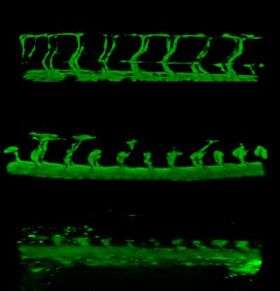
ScA causes microvessel death in zebrafish. Credit: K. Stoletov/R. Klemke

A collaborative team of researchers spearheaded by Dennis Carson M.D., professor of medicine and director of the Rebecca and John Moores UCSD Cancer Center at the University of California, San Diego (UCSD) has identified a potent new anti-cancer drug isolated from a toxic blue-green algae found in the South Pacific. The properties of somocystinamide A (ScA) are described in a paper that will be published online in Proceedings of the National Academy of Science the week of February 11 -15.

“We are excited because we have discovered a structurally unique and highly potent cancer-fighting compound,” said Dwayne G. Stupack, associate professor of pathology at the Moores UCSD Cancer Center. “We envision it will be perfect for emerging technology, particularly nanotechnology, which is being developed to target cancerous tumors without toxic side effects.”

The ScA compound was found in the cyanobacteria L. Majuscula, also known as “mermaid’s hair,” gathered off the coast of Fiji in the South Pacific by the laboratory of William Gerwick at Scripps Institution of Oceanography. A diverse team of researchers from UCSD’s Cancer Center, School of Medicine, Skaggs School of Pharmacy and Pharmaceutical Sciences, and Scripps worked to identify, screen and test marine compounds in vitro and in vivo. They found that ScA inhibits neovascularization, the formation of blood vessels that feed tumors, and also had a direct impact on tumor cell proliferation.

“The compound isn’t toxic to the cyanobacteria itself, but activates a ‘death pathway’, present in our cells,” said Stupack. “When the cells of the blood vessels that feed tumors become activated and proliferate, they become especially sensitive to this agent.”

Gerwick noted that if a normal-sized swimming pool full of cancer cells were treated with ScA, it would take only three milligrams – about the weight of a grain of rice – to kill all of the cancer cells.

Wolf Wrasidlo, Ph.D., senior project scientist at the Moores UCSD Cancer Center and first author of the work, added that the unique structure of this compound lends itself very well to nanotechnology, because it “incorporates spontaneously” into molecule-sized nanoparticles, important for the kind of highly targeted, combination therapy being developed to treat cancer. The structure is also simple enough that the scientists can reproduce it.

“ScA is the first, and most potent compound we’ve identified so far,” Stupack said, adding that it won’t be the last, as the Scripps team has identified more than 250 unique compounds from L. Majuscula alone. “But we don’t yet know how abundant ScA is, or if it’s feasible to harvest, so it is important that we have been able to produce this natural product in the lab.”

Source: University of California - San Diego

Explore further: ASCO: combo antibody therapy effective for melanoma

add to favorites email to friend print save as pdf

Related Stories

Bonaparte family letter to return to France

48 minutes ago

(Phys.org) —A handwritten letter dated April 27, 1792, signed by Joseph Bonaparte and referring to a skirmish in Corsica involving Napoleon, the writer's then 22-year-old brother, will be returned to its ...

British children's on-screen reading overtakes books

48 minutes ago

For the first time, British children are reading more on computers and other electronic devices than they are reading books, magazines, newspapers and comics, according to a study of nearly 35,000 youngsters ...

CTRL+P: Printing Australia's largest solar cells

58 minutes ago

(Phys.org) —The printer has allowed researchers from the Victorian Organic Solar Cell Consortium (VICOSC) – a collaboration between CSIRO, The University of Melbourne, Monash University and industry partners ...

Novel probe for live human iPS cell imaging

1 hour ago

Researchers from the National Institute of Advanced Industrial Science and Technology (AIST) have developed a highly sensitive lectin probe, rBC2LCN, for human induced pluripotent stem cells (iPS cells). ...

Recommended for you

New colonoscope provides ground-breaking view of colon

5 hours ago

A ground-breaking advance in colonoscopy technology signals the future of colorectal care, according to research presented today at Digestive Disease Week(DDW). Additional research focuses on optimizing the minimal withdrawal ...

ASCO: combo antibody therapy effective for melanoma

May 17, 2013

(HealthDay)—Concurrent use of two immune checkpoint antibodies—ipilimumab and nivolumab—may be effective for the treatment of advanced melanoma, according to a proof-of-principal study presented in ...

Risk factors ID'd for poor cutaneous cell CA outcomes

May 17, 2013

(HealthDay)—The risks of metastasis and death associated with cutaneous squamous cell carcinoma (CSCC) are low, but significant, and risk factors for poor outcome include tumor diameter, invasion beyond ...

User comments : 0

More news stories

US psychiatry gets makeover in new manual

The latest makeover to a massive psychiatric tome honored by some, reviled by others and even called the "Bible" of mental disorders is being released Saturday with a host of new changes.

New case of SARS-like virus in Saudi: ministry

A new case of the deadly coronavirus has been detected in Saudi Arabia where 15 people have already died after contracting it, the health ministry announced on Saturday on its Internet website.

New colonoscope provides ground-breaking view of colon

A ground-breaking advance in colonoscopy technology signals the future of colorectal care, according to research presented today at Digestive Disease Week(DDW). Additional research focuses on optimizing the minimal withdrawal ...

Galaxy's Ring of Fire

Johnny Cash may have preferred this galaxy's burning ring of fire to the one he sang about falling into in his popular song. The "starburst ring" seen at center in red and yellow hues is not the product of ...

US seizes Bitcoin operator accounts

US authorities seized the accounts of a Bitcoin digital currency exchange operator, claiming it was functioning as an "unlicensed money service business," court documents showed Friday.