Skin care: new research into scar-free healing
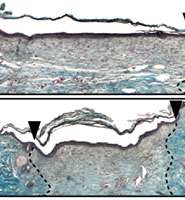
New research from the University of Bristol shows that by suppressing one of the genes that normally switches on in wound cells, wounds can heal faster and reduce scarring. This has major implications not just for wound victims but also for people who suffer organ tissue damage through illness or abdominal surgery.
When skin is damaged a blood clot forms and cells underneath the wound start to repair the damage, leading to scarring. Scarring is a natural part of tissue repair and is most obvious where skin has healed after a cut or burn. It ranges from trivial (a grazed knee) to chronic (diabetic leg ulcers) and is not limited to the skin. All tissues scar as they repair; for example, alcohol-induced liver damage leads to fibrosis and liver failure, and after most abdominal surgeries scars can often lead to major complications.
Tissue damage triggers an inflammatory response by white cells to protect skin from infection by killing microbes. The same white cells guide the production of layers of collagen. These layers of collagen help the wound heal but they stand out from the surrounding skin and result in scarring. Research by Professor Paul Martin and colleagues at the University of Bristol shows that osteopontin (OPN) is one of the genes that triggers scarring and that applying a gel, which suppresses OPN to the wound, can accelerate healing and reduces scarring. It does this in part by increasing the regeneration of blood vessels around the wound and speeding up tissue reconstruction.
The findings will be published by the Journal of Experimental Medicine on 26 January in a paper entitled ‘Molecular mechanisms linking wound inflammation and fibrosis: knockdown of osteopontin leads to rapid repair and reduced scarring’. The paper is available online now.
Speaking of the discovery, Professor Martin said: ‘White blood cells (macrophages), and the chemical signals (PDGF) delivered to the wound cells, and osteopontin itself are now all clear targets for developing medicines to improve healing of skin wounds and other organs where fibrotic tissue repair can be debilitating. We hope that it won’t be too long before such therapies are available in the clinic. Indeed, the technique for suppressing OPN to reduce scarring is currently being licensed and patented by a Biotech company specializing in wound-healing therapies.’
Earlier research by Professor Martin’s lab and others has shown that embryos of many species, including humans, heal wounds without leaving a scar. Now it looks like the same may be true for adults.
Source: University of Bristol


