Probing Question: Why can a stroke victim remember some things and not others?
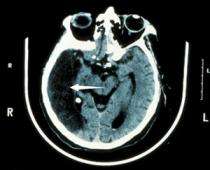
The brain is the most beautifully complex organ in the human body. Three pounds of evolutionary genius, the brain provides both the hardware and software for controlling all behavior through an intricate system of synaptic messaging.
But for all of its complexity, the brain is sustained by oxygen-rich arteries and blood vessels and can't survive without the free flow of blood to all of its lovely lobes and fissures, which is exactly what a stroke inhibits. When someone suffers a stroke, blood flow to that person's brain suddenly stops. The location of the stroke, how long the blood flow was interrupted, and the extent of the permanent damage will determine the stroke victim's long-term prognosis.
Strokes are the third leading cause of death in the United States, with at least 80 percent classified as ischemic, occurring when blood flow to the brain is interrupted, usually as a result of a blood clot or embolism. The other type of stroke, hemorhaggic, is caused when blood vessels break and leak into the brain and damage brain tissue, and is more deadly. What some people call "mini-strokes," TIAs, or trans-ischemic attacks, are not strokes at all, although they provide valuable warning signs for full-blown strokes. A true stroke — however stark or slight — leaves its mark on the body, or mind.
According to Kevin Cockroft, associate professor of neurosurgery and co-director of the Penn State Stroke Center, the damage caused by a stroke depends on what vessel is occluded and what territory is affected. "That middle cerebral artery is the common artery on the hemisphere of the brain. If the whole territory on the brain is damaged, it can lead to weakness and paralysis, as well as language dysfunction if it's on the left side," he said. "But some small branches of that artery may lead to language impairment rather than weakness."
Many stroke victims experience aphasia, the loss of speech or the inability to understand speech. Anomia, the inability to name things, is a subtype of aphasia. "The other thing that comes into play is memory and retrieving memory," said Cockroft. "It becomes difficult for stroke patients to make new memories, whereas they can be very good about remembering things in the past."
Cockcroft said he tells the families of stroke patients to expect two things: "One, there will always be a personality change, maybe so subtle that only the family notices, or so pronounced that everyone notices. Second, they will always have some problems with their short-term memory. How long it will last is hard to say."
For some patients, short-term memory is so impaired that they can't form new memories at all. For instance, they can't remember what they ate for breakfast, yet they are able to recall something they knew years ago, such as the nickname of New Orleans. This inability to form new memories is called anterograde amnesia — a condition that provided the plotline for the movies "Memento" and "Fifty First Dates," although anterograde amnesia is much more common as the result of a stroke than a concussion.
Cockroft emphasized that there has been a lot of progress made in stroke care in the last decade, but public education remains a key factor in improving patient outcomes. "It's important to think of a stroke as a 'brain attack,'" he explained. "It requires immediate attention." Every minute counts: If blocked blood vessels can be cleared within three to six hours, the patient's odds are greatly improved. Within that crucial window of time, clot-busting drugs can be administered intravenously or intra-arterially. If the patient seeks medical care six hours or more after the initial stroke, or in cases where the clot-busting drugs don't work, there are still other options, Cockroft added. After eight hours, a Merci retrieval device, which looks like a corkscrew, can be used to fish out a clot. After 10 hours, a balloon catheter can be used to increase circulation around the blood vessels damaged by the stroke.
The crucial thing to remember, noted Cockroft, is "If you're having numbness, weakness, loss of vision, or sudden headaches, you need to get to the emergency room."
Source: By Gigi Marino, Research Penn State


