Electrical fields from everyday equipment and materials could increase infection risk
Electrical fields generated by everyday electrical equipment such as computers, and excess static charge created by many modern materials, could be bad for your health, says new research published by Imperial scientists.
The study, published in the Atmospheric Environment journal in August 2007, strongly indicates that prolonged exposure to the electric fields generated in everyday indoor environments may cause increased risk of respiratory diseases and infection from small airborne particles such as allergens, bacteria and viruses. The study also found that such risks may be far higher than previously thought.
These electrical fields have also been shown by the authors to significantly reduce localised concentrations of charged molecular oxygen, a type of small air ion, that enhances biological functioning and kills harmful microbes.
Over 90 per cent of airborne particles can be in the size range which is affected by these fields - less than one micron in size, 80 times smaller than a human hair. Whilst they can remain air-borne almost indefinitely, deposition of these tiny particles in people's lungs and on their skin can be greatly increased by electric field effects, particularly when they are in close proximity to oppositely charged surfaces.
Lung deposition of such particles can be increased as a result of the electrostatic charge they hold causing "mirror" charges of opposite polarity to be induced on the neutral surface of the respiratory tract, thereby increasing their deposition over uncharged and charge neutralized particles.
Electric field levels can also vary with the humidity levels of the air, with below 20-30 per cent relative humidity causing marked increases in the level of fields that can be generated and thereby increasing incidents of deposition and infection.
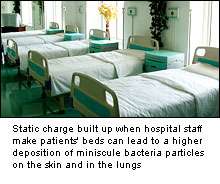
The researchers suggest that the presence of such fields indoors may cause a significant increase in the deposits of this kind of particles in people's lungs and on their skin. In addition to relative constant field levels, temporary incidents of excess charge, which occur through fictional charging of certain materials - such as when a hospital worker makes up a patient’s bed - can further increase likelihood of contamination.
Increased deposition of these particles increases the toxic load that the body has to deal with, raising the risk of contamination, bacterial infection and incidence of conditions such as asthma. Additionally, surface contamination can prove harder to remove, as particles’ deposition speeds are increased under high fields causing greater deformation on impact, making them stick harder to the surfaces they land on.
Keith Jamieson of Imperial's Centre for Environmental Policy, lead author of the paper, says: "Many of the factors that can cause high electric fields and increased deposition and contamination are often found in hospital ward environments and in buildings where incidents of sick building syndrome are noted."
The researchers propose, however, that adopting a number of simple guidelines in home, office and hospital environments could reduce the size of electrical fields generated, and therefore reduce the levels of potentially unhealthy particles deposited on the skin and in the lungs as well as making surface contamination far easier to remove.
Keith Jamieson explains: "In the case of electrical equipment, particularly laptops, ensuring they are earthed can often greatly reduce fields. In terms of the electrostatic charge generated by people themselves, careful selection of materials and humidity levels can significantly reduce problems as can balanced bipolar air ionisation. Trying to avoid spending time in areas where high fields are created, and unplugging electrical equipment when not in use, are also good options - so there are a number of easy actions which can already be implemented in the workplace and the home to help reduce the toxic load our bodies have to deal with and the risk of illness and infection being transmitted in this way."
Source: ICL


