Outbreak in Europe blamed on 'super-toxic' strain (Update 2)
(AP) -- Scientists on Thursday blamed Europe's worst recorded food-poisoning outbreak on a "super-toxic" strain of E. coli bacteria that may be brand new.
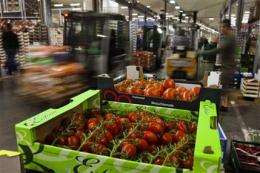
But while suspicion has fallen on raw tomatoes, cucumbers and lettuce as the source of the germ, researchers have been unable to pinpoint the food responsible for the frightening illness, which has killed at least 18 people, sickened more than 1,600 and spread to least 10 European countries.
An alarmingly large number of victims - about 500 - have developed kidney complications that can be deadly.
Chinese and German scientists analyzed the DNA of the E. coli bacteria and determined that the outbreak was caused by "an entirely new, super-toxic" strain that contains several antibiotic-resistant genes, according to a statement from the Shenzhen, China-based laboratory BGI. It said the strain appeared to be a combination of two types of E. coli.
"This is a unique strain that has never been isolated from patients before," Hilde Kruse, a food safety expert at the World Health Organization, told The Associated Press. The new strain has "various characteristics that make it more virulent and toxin-producing" than the many E. coli strains people naturally carry in their intestines.
However, Dr. Robert Tauxe, a foodborne-disease expert at the U.S. Centers for Disease Control and Prevention, questioned whether the strain is truly new, saying it had previously caused a single case in Korea in the 1990s. He said genetic fingerprints may vary from specimen to specimen, but that is not necessarily enough to constitute a new strain.
"Though it appears to have been around awhile, it hasn't called attention to itself as a major public health problem before," Tauxe said.
Elsewhere in Europe, Russia extended a ban on vegetables from Spain and Germany to the entire European Union to try to stop the outbreak spreading east, a move the EU quickly called disproportionate and Italy's farmers denounced as "absurd." No deaths or infections have been reported in Russia.
In Hamburg, Philipp, a 29-year-old photojournalist, was hospitalized on Monday after falling ill. He would not provide his last name because he did not want people to know he had the E. coli strain.
After suffering from stomach aches and bloody stools, he developed neurological symptoms and couldn't feel his left arm or leg. Despite three blood plasma transfusions to wash the toxins out of his blood, he hasn't improved.
Philipp said he recalls eating some vegetables the night before he got sick.
Some scientists suspect the deadly E. coli might have been in manure used to fertilize vegetables.
Kruse said it is not uncommon for bacteria to evolve and swap genes. It is difficult to explain where the new strain came from, she said, but bacteria from humans and animals easily trade genes.
Previous E. coli outbreaks have mainly hit children and the elderly, but this one is disproportionately affecting adults, especially women. Kruse said there might be something particular about the bacteria strain that makes it more dangerous for adults. Other experts said women tend to eat more produce.
Nearly all the sick either live in Germany or recently traveled there. British officials announced four new cases, including three Britons who recently visited Germany and a German on vacation in England.
The WHO recommends that to avoid food-borne illnesses, people wash their hands, keep raw meat separate from other foods, thoroughly cook their food, and wash fruits and vegetables, especially if eaten raw. Experts also recommend peeling raw fruits and vegetables if possible.
The fact that the strain may be new may have complicated the response to the outbreak.
"Officials may not have had the correct tests to detect it, which may explain the initial delay in reporting," said Paul Hunter, a professor of health protection at the University of East Anglia in England.
He said the number of new cases would probably slow to a trickle in the next few days. The incubation period for this type of E. coli is about three to eight days. "Salads have a relatively short shelf life and it's likely the contaminated food would have been consumed in one to two weeks," Hunter said.
But Hunter warned the outbreak could continue if there is secondary transmission of the disease, which often happens when children are infected. E. coli is present in feces and can be spread by sloppy bathroom habits, such as failure to wash one's hands.
Meanwhile, Spanish Prime Minister Jose Luis Rodriguez Zapatero slammed the European Commission and Germany for singling out the country's produce early on as a possible source of the outbreak, and said the government would demand "conclusive explanations and sufficient reparations."
Spanish farmers say the accusations have devastated their credibility and exports. In Valencia, protesting farmers dumped some 300 kilos (700 pounds) of fruit and vegetables - cabbage, tomatoes, peppers, cucumbers and other produce - outside the German consulate.
The outbreak is already considered the third-largest involving E. coli in recent world history, and it may be the deadliest. Twelve people died in a 1996 Japanese outbreak that reportedly sickened more than 9,000, and seven died in a Canadian outbreak in 2000.
©2011 The Associated Press. All rights reserved. This material may not be published, broadcast, rewritten or redistributed.


