How to square budget cuts, need for aging research
(AP) -- A disease standoff may be brewing: How can Alzheimer's research receive more scarce dollars without cutting from areas like heart disease or cancer?
In one of the stark realities of the budget crisis, scientists' chances of winning research dollars from the National Institutes of Health for any condition have dipped to a new low.
"We are clearly not able to support a lot of great science that we would like to support," NIH Director Dr. Francis Collins told senators last week. This year, for every six grant applications that NIH receives, "five of them are going to go begging."
That's down from nearly 1 in 3 grants funded a decade ago, and 1 in 5 last year. And it comes before the looming fight over how much more to cut in overall government spending for next year, and where to make those cuts.
Already, a new report says one of the biggest losers is aging research, despite a rapidly graying population that promises a worsening epidemic of dementia, among other illnesses.
"Nobody wants to say Alzheimer's is worse than diabetes or heart disease or cancer," says Dr. Sam Gandy, a prominent neuroscientist at New York's Mount Sinai School of Medicine.
But "part of the problem now with all the pressure to cut the budget ... is that for Alzheimer's to get more, something else has to lose," adds Gandy. His own lab is scrambling for funds to study a potential dementia drug after losing out on an NIH aging grant.
The NIH pays for much of the nation's leading biomedical research. Republicans and Democrats alike have long been staunch supporters. But the agency's nearly $31 billion budget offers an example of the hard choices facing lawmakers, especially if they're to meet House calls for a drastic scale-back of overall government spending.
Consider aging issues.
The NIH spends about $469 million on Alzheimer's research, says a new report from the Alzheimer's Foundation of America that criticizes overall aging research as "a minuscule and declining investment."
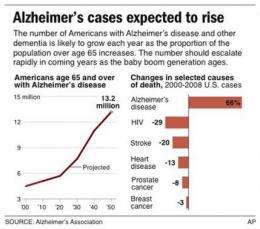
About 5.4 million Americans now have Alzheimer's disease, and studies suggest health and nursing home expenditures for it cost more than $170 billion a year, much of it paid by Medicare and Medicaid.
NIH's Collins told a Senate appropriations subcommittee that there's a "very frightening cost curve." In 2050, when more than 13 million Americans are projected to have Alzheimer's, the bill is expected to reach a staggering $1 trillion. But he said that cost could be halved merely by finding a way to delay people getting Alzheimer's by five years.
Monday, Republican presidential contender Newt Gingrich jumped into the debate, saying that over the next four decades Alzheimer's could cost the government a total of $20 trillion. He suggested selling U.S. bonds to raise money for research rather than have the disease compete each year for a share of the federal budget.
"We are grotesquely underfunded," Gingrich said of health research dollars.
The Alzheimer's Foundation report goes beyond dementia, finding that the National Institute on Aging receives 3.6 cents for every dollar Congress sends to the NIH. Cancer and heart disease get nearly three to four times as much. Despite the tough economic times, the foundation has joined with other groups lobbying for an extra $300 million for the aging institute's overall work next year, to boost its budget to $1.4 billion.
Competition for today's dollars is fierce, with applications up 60 percent at the aging division alone since 2003. Aging chief Dr. Richard Hodes says last year, his institute couldn't pay for about half of what were ranked as the most outstanding applications for research projects. Still, he hopes to fund more scientists this year by limiting the number who get especially large grants.
What's the squeeze? Congress doubled the NIH's budget in the early 2000s, an investment that helped speed the genetic revolution and thus a host of new projects that scientists are clamoring to try. But in more recent years, economists say NIH's budget hasn't kept pace with medical inflation, and this year Congress cut overall NIH funding by 1 percent, less than expected after a protracted battle.
The Obama administration has sought nearly $32 billion for next year, and prospects for avoiding a cut instead are far from clear. Sen. Tom Harkin, D-Iowa, who chairs the subcommittee that oversees the issue, warns that under some early-circulating House plans to curb health spending, "severe reductions to NIH research would be unavoidable. That doesn't make sense."
Sen. Jerry Moran, R-Kan., pushed Collins to make the case that investments in medical research really can pay off.
Collins' response: Four decades of NIH-led research revealed how arteries get clogged and spurred development of cholesterol-fighting statin drugs, helping lead to a 60 percent drop in heart-disease deaths. Averaged out, that research cost about $3.70 per person per year, "the cost of a latte, and not even a grande latte," Collins told lawmakers.
©2011 The Associated Press. All rights reserved. This material may not be published, broadcast, rewritten or redistributed.


