Signaling pathway reveals mechanism for B cell differentiation in immune response
Apr 22, 2011
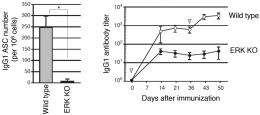
Figure 1: ERK KO mice showed impaired IgG1 antibody production Wild type and ERK KO mice were immunized and the number of antigen-specific IgG1 antibody-secreting cells (ASC) (left) and antibody titer in sera was measured (right). Both the number of ASC and antibody titers were reduced in ERK KO mice.

The finding establishes a role for the extracellular signal-regulated kinase (ERK) signaling pathway in B cell differentiation, a key step toward the development of B cell-targeted drugs for treatment of autoimmune diseases and allergies.

As the only cells in the body that produce antibodies, B cells play an essential role in the ’s defense against bacteria and viruses. Differentiation of B cells into antibody-producing plasma cells is central to this role, initiating the production of antibodies whose targeted binding mechanism enables the immune system to identify and neutralize foreign objects. The mechanism underlying this differentiation process, however, remains unknown.

To better understand this mechanism, the research group focused on the signaling of the extracellular signal-regulated kinases (ERK), intracellular signaling molecules known to play an important role in the cell cycle and survival of immune cells. Hoping to glean insights into the role of ERKs in B into plasma cells, the researchers generated mice deficient in two different ERKs, ERK1 and ERK2, and studied the effect of this deficiency on the fate of B cells.
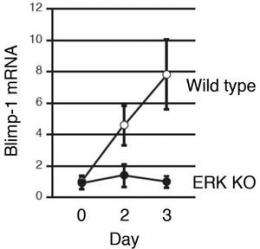
Figure 2: ERKs are essential for the induction of Blimp-1 Purified B cells were stimulated with anti-CD40 and IL-4 for the number of days indicated, and the amount of Blimp-1 mRNA was measured. Blimp-1 was induced in wild type mice, but not in ERK KO mice.

What they found confirmed that ERKs are in fact essential to B cell differentiation: in mice without these key molecules were unable to form plasma cells (Figure 1). The researchers further traced this observation to a gene called Prdm1 encoding the protein BLIMP-1, increased expression of which leads to differentiation and proliferation of plasma cells in B cell immune response (Figure 2). ERKs, they discovered, phosphorylate the transcription factor Elk1, which leads to expression of Blimp-1 (Figure 3).
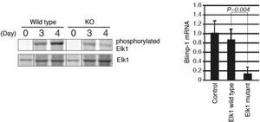
Figure 3: ERKs are required for the phosphorylation of Elk1 In vitro stimulated cells (similar to Figure 2) were subjected to Western Blotting analysis. ERK KO B cells showed impaired Elk1 phosphorylation (left). B cells with the mutant Elk1, which are genetically modified not to be phosphorylated by ERKs, showed impaired Blimp-1 induction (right).

By elucidating the role of ERKs in B cell differentiation, the current research provides valuable insight into a little-understood area of immune response, promising advances in drug discovery and offering hope to autoimmune disease and allergy sufferers around the world.

Explore further: SUMO wrestling cells reveal new protective mechanism target for stroke

More information: T. Yasuda, et al., ERKs induce expression of the transcriptional repressor Blimp-1 and subsequent plasma cell differentiation. Sci. Signal. 4, ra25 (2011). DOI: 10.1126/scisignal.2001592

add to favorites email to friend print save as pdf

Related Stories

Protein helps immune cells to divide and conquer

Mar 08, 2009

Researchers at the University of California, San Diego School of Medicine have identified a key protein that is required for immune cells called B lymphocytes to divide and replicate themselves. The rapid generation of large ...

Protein is key to embryonic stem cell differentiation

Mar 18, 2009

Investigators at Burnham Institute for Medical Research (Burnham) have learned that a protein called Shp2 plays a critical role in the pathways that control decisions for differentiation or self-renewal in both human embryonic ...

Recommended for you

Preventing blood poisoning

23 hours ago

Peptide molecules derived from the body's natural immune system can help boost the body's defence against life-threatening blood poisoning, joint University research has uncovered.

User comments : 0

More news stories

Temporal processing in the olfactory system

The neural machinery underlying our olfactory sense continues to be an enigma for neuroscience. A recent review in Neuron seeks to expand traditional ideas about how neurons in the olfactory bulb might encode information about ...

US seizes Bitcoin operator accounts

US authorities seized the accounts of a Bitcoin digital currency exchange operator, claiming it was functioning as an "unlicensed money service business," court documents showed Friday.

Alaska volcano shoots ash 15,000 feet into the air

(AP)—One of Alaska's most restless volcanoes has shot an ash cloud 15,000 feet into the air in an ongoing eruption that has drawn attention from a nearby community but isn't expected to threaten air traffic.

Chinese, Indian airlines face EU pollution fines

Eight Chinese and two Indian airlines face fines of up to several million euros for not paying for their greenhouse gas emissions during flights within the bloc, the European Commission said on Friday.