Major advance for bionic eye
April 1, 2011

Major advance for bionic eye

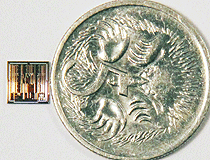
Microchip for bionic eye

(PhysOrg.com) -- University of New South Wales researchers have unveiled the microchip which is expected to power Australiaэs first bionic eye.

Associate Professor Gregg Suaning, of the Graduate School of Biomedical Engineering and a project leader in the national consortium, Bionic Vision Australia (BVA), said the new, 98-channel microchip, now undergoing preliminary lab testing, was a major step towards the goal of a functional bionic eye.

“This is a remarkable new microchip that has brought an Australian retinal implant much closer to reality,” he said.

“At only five square millimetres, the device is tiny but represents a significant advance in nerve stimulation technology. The design team incorporated never-before attempted features with this design and they absolutely nailed every aspect. The result is mind boggling.”

BVA Director, Professor Anthony Burkitt, said the production of the chip, a year after BVA received funding for the bionic eye project, represented “a major advance in technology”.

“This microchip is at the heart of the retinal implant, which stimulates the retinal cells to elicit vision. It is an important component in the development of our first bionic vision system that may provide real, functional benefits for patients and make our technology competitive internationally,” he said.

The is performing well in preliminary lab testing. It will be at the core of the Wide-View neurostimulator device being developed by BVA, with the first full implant of the system in a patient planned for 2013.

The bionic eye technology being developed by UNSW and its partners in BVA – the Bionic Ear Institute, Centre for Eye Research Australia, NICTA and University of Melbourne – aims to help people who have experienced vision loss due to retinitis pigmentosa (RP) and age-related macular degeneration (AMD). RP affects 1.5 million people around the world, while AMD is responsible for almost half of all legal blindness in Australia. For more information on RP, AMD and the bionic eye project visit the BVA website.

Provided by University of New South Wales search and more info website

Filter


Move the slider to adjust rank threshold, so that you can hide some of the comments.


Display comments: newest first

Skeptic_Heretic
Apr 01, 2011

Rank: not rated yet
Amazing. I would've never thought these sorts of things would become manifest in my lifetime. Now anyone up for a pool on how long it takes to make the implant better than the original? I'll put my money on 40 years, barring any sort of extreme circumstance.
RobertC
Apr 01, 2011

Rank: not rated yet
Skeptic Heretic,

I would say within 10 years. This is essentually mores law, so sooner than you would expect

Mesafina
Apr 01, 2011

Rank: not rated yet
well they will increase the resolution of these nerve stimulation chips greatly in the next decade or two. Only time will tell when it has "surpassed" the natural eye, but it is a subjective question... some could argue the moment they add night vision to them that they are "better" in some ways, even at lower resolution.
trekgeek1
Apr 01, 2011

Rank: 5 / 5 (1)
Can we put an American coin in the picture for scale? I was thinking "that chip is much smaller than that coin, but how big is that coin"? Ha, I'm so American-centric.
soulman
Apr 02, 2011

Rank: 2.3 / 5 (3)
Can we put an American coin in the picture for scale? I was thinking "that chip is much smaller than that coin, but how big is that coin"?

The coin is 19.41 mm in diameter, or in archaic units, 0.764 inches :)

I would have liked to have known what resolutions the implant is capable of generating, ie, how it compares with normal vision.

There have been previous chip implants which I think worked on a different principle as they acted like a CCD camera replacing the retina. These devices have very crude resolutions - no better than sensing differences in light and dark, but people can still benefit from them.

These chips don't appear to replace the retina, but stimulate it to make it work better, so the results could be a lot better. But if so, then this tech will never produce results better than the original eye as it's still utilizing the retina for sensing.
nada
Apr 03, 2011

Rank: 1 / 5 (2)
These types of devices are worthless because the still depend on the person having a good optic nerve. Also the article is flat wrong. Glaucoma is the NUMBER ONE leading cause of blindness. And these types of devices are worthless for those people.

When you read "implantable transducers in the eye" they might as well be saying "we are blowing funding money on worthless techology".

The article talks about the cochlear implants. Cochlear implants SOLVE the problem because the wires are implanted IN THE BRAIN. Think out worthless the cochlear implant device would be if the wires attached to the ear drum. THAT is how worthless this eye device is.

Until they start implanting signal wires into the brain and bypass the optic nerve - this is all just wasting tax payer money and playing in the sandbox.

And its a disgrace on the medical research community that we don't have an artifical eye STILL. Definately not the fault of the CCD camera technology - that technology is out their.
PaulieMac
Apr 04, 2011

Rank: 5 / 5 (1)
These types of devices are worthless


Tell that to the millions of people this technology may help to see again. Moron.
nada
Apr 05, 2011

Rank: 1 / 5 (1)
These types of devices are worthless


Tell that to the millions of people this technology may help to see again. Moron.


If you didn't have sh1t for brains you would realize bypassing the optic nerve would work for those people ALSO.

So basically in your ignorace you called me a moron for wanting technology that can help ALL eye conditions instead of a few. Who's the moron now?
PaulieMac
Apr 08, 2011

Rank: not rated yet
You know what - you're right. Your imaginary solutions are much more valuable than the actual medical advances these people are making.

Hmm.. I'm somewhat curious, though.. Instead of bleating and ranting on some obscure corner of the net that the trained experts are 'doing it all wrong'... Why aren't you out there curing all those millions of sightless people? Especially since it is all so obvious and simple. You'd be rich as the stars - probably a Nobel in it for you, too...
nada
Apr 09, 2011

Rank: not rated yet
You know what - you're right. Your imaginary solutions are much more valuable than the actual medical advances these people are making.

Hmm.. I'm somewhat curious, though.. Instead of bleating and ranting on some obscure corner of the net that the trained experts are 'doing it all wrong'... Why aren't you out there curing all those millions of sightless people? Especially since it is all so obvious and simple. You'd be rich as the stars - probably a Nobel in it for you, too...


Actually I do have a design and have found designs similar to mine on the web being worked on. I'm an Electrical Engineer and my wife suffers from glaucoma - so why don't you take your arrogant scientic police attitude and stuff it a ss ho le.
nada
Apr 09, 2011

Rank: not rated yet
PaulieMac: Maybe if you actually KNEW anyone that is suffering from vision loss you would understand my point and you wouldn't be such a public dum b as s. Your defense of the pride of scientists over actually helping people is pathetic.
nada
Apr 09, 2011

Rank: not rated yet
PaulieMac, So lets hear your contribution to anything: Are you an engineer? Are you a Doctor? Do you even have a high school diploma? You're so vocal about my statement, lets hear your story. Do you have a vision issue? Do you know anyone who does?

Didn't think so. Mommy's calling you, brush your teeth before you go beddy-bye.
PaulieMac
Apr 11, 2011

Rank: not rated yet

Actually I do have a design and have found designs similar to mine on the web being worked on.


Well, I look forward to reading of your breakthroughs on this or some some other site... At which point, I will applaud you, in the same way as I applaud the researchers in this article :)
PaulieMac
Apr 11, 2011

Rank: not rated yet
PaulieMac: Maybe if you actually KNEW anyone that is suffering from vision loss you would understand my point and you wouldn't be such a public dum b as s. Your defense of the pride of scientists over actually helping people is pathetic.


You think there is a single adult on this planet who does *not* know someone suffering from vision impairment or loss?

'Defence of the pride of scientists over helping people'? This team has a functioning device in testing; hopefuly going it will help someone see again within 2 or 3 years. So, yes, I say 'good job' to them; I say 'fantastic'. It's exciting news, and I earnestly hope it goes on to help millions more people regain their sight.

You have a problem with that? You prefer all those millions get left in the dark until the perfect fix is achieved? For how long? An extra 1 year? 5? 10?

That'll sure show all those darned 'scientific' types ;-)
Rank 5 /5 (3 votes)
Relevant PhysicsForums posts
  • Potential Breakthrough in Seizure Control
    created22 hours ago
  • Popping/Cracked sternum.
    createdMay 25, 2012
  • Which Mental Illness Encompasses This Problem?
    createdMay 25, 2012
  • A question about drug tolerance
    createdMay 23, 2012
  • Poor nutrition leading to overeating?
    createdMay 23, 2012
  • Math and dyslexia?
    createdMay 21, 2012
  • More from Physics Forums - Medical Sciences

More news stories

Keep food safety in mind this memorial day weekend

(HealthDay) -- Picnics, parades and cookouts are as much a part of Memorial Day weekend as tributes to the United States' war veterans.

Medicine & Health / Health

created 8 hours ago | popularity not rated yet | comments 0

Family history of Alzheimer's affects functional connectivity

(HealthDay) -- Cognitively normal individuals with a family history of late-onset Alzheimer's disease (AD) may display lower resting state functional connectivity in the default mode network (DMN) of the brain, ...

Medicine & Health / Alzheimer's disease & dementia

created 17 hours ago | popularity not rated yet | comments 0

Transvaginal mesh op restores pelvic organ prolapse at price

(HealthDay) -- Transvaginal mesh (TVM) procedures are effective for anatomical restoration of pelvic organ prolapse (POP), but patients report a worsening of sexual function following surgery, according to ...

Medicine & Health / Other

created 17 hours ago | popularity not rated yet | comments 0

Travel to high altitudes tied to Crohn's, colitis flare-ups

(HealthDay) -- People with inflammatory bowel disease, which includes Crohn's disease and colitis, may be at increased risk for flare-ups when they fly or travel to high altitudes for skiing or mountain climbing, ...

Medicine & Health / Inflammatory disorders

created 18 hours ago | popularity not rated yet | comments 1 | with audio podcast

Weight struggles? Blame new neurons in your hypothalamus

New nerve cells formed in a select part of the brain could hold considerable sway over how much you eat and consequently weigh, new animal research by Johns Hopkins scientists suggests in a study published in the May issue ...

Medicine & Health / Neuroscience

created May 21, 2012 | popularity 5 / 5 (1) | comments 6 | with audio podcast


Scientist: Evolution debate will soon be history

(AP) -- Richard Leakey predicts skepticism over evolution will soon be history. Not that the avowed atheist has any doubts himself.

Dell tablet leak: 10.1-inch display, two-battery choice

(Phys.org) -- Headline after headline talks about vendors’ tablets in the wings as likely number-one contenders for the iPad. Such claims have justifiably been taken with a grain of salt, considering ...

SpotterRF debuts Radar Backpack Kit (w/ Video)

(Phys.org) -- SpotterRF has announced a special radar backpack kit designed to enhance situational awareness for soldiers on the ground. The company says its special radar is designed for warfighters as part ...

SpaceX capsule has 'new car' smell, astronauts say (Update)

SpaceX's Dragon cargo vessel smells like a new car, said astronauts at the International Space Station after opening the hatches Saturday following the spacecraft's landmark mission to the orbiting lab.

Thousands of shellfish found dead in Peru

Thousands of crustaceans were found dead off the coast of Lima following the mystery mass death of dolphins and pelicans, the Peruvian Navy said Friday.

Astronomers seize last chance in lifetime for Venus Transit

Astronomers are gearing for one the rarest events in the Solar System: an alignment of Earth, Venus and the Sun that will not be seen for another 105 years.