Diabetes treatment may also provide protection against endometrial cancer
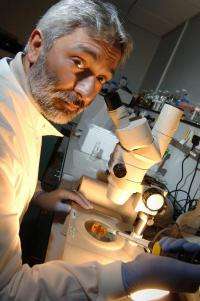
This is Dr. Harpal Randeva of Warwick Medical School. Credit: University of Warwick Medical
Research led by Warwick Medical School at the University of Warwick has found that Metformin, a drug treatment used to treat diabetes and also in women with Polycystic vary syndrome (PCOS), may potentially provide protection against endometrial cancer.
Endometrial cancer is the most common malignancy of the female genital tract and the fourth most common cancer in women in the UK and the US. Up to a third of PCOS women also have endometrial hyperplasia which, in turn predisposes these women to endometrial cancer. PCOS affects 5%-10% of women of reproductive age, where Metformin ameliorates insulin resistance and hyperinsulinemia in these women, but also long-term use of Metformin improves ovulation and menstrual cycle regularity.
Recent research has found that Metformin has anti-cancer properties e.g. in breast cancer. Given that insulin resistant states, e.g. obesity, diabetes and PCOS are more at risk of developing endometrial cancer, the Warwick researchers studied the effects of metformin treatment on endometrial cancer cells. The researchers used serum from control and PCOS (before and after metformin treatment) subjects and carried out basic scientific experiments on endometrial cancer cells. The experiments revealed a decrease in endometrial cancer cell invasiveness in sera from metformin treated PCOS women.
The researchers found that serum samples from PCOS women who had completed the 6 month course of Metformin the rate of spread of endometrial cancer cells was around 25% lower than in the serum samples from PCOS women who had not started that treatment.
The principal investigators, Dr Harpal Randeva and Dr Bee K Tan, at Warwick Medical School said:
"We are very excited about our findings, which reveal the significant impact of Metformin therapy use on human endometrial cancer cells. However, it is prudent that further research to explore if Metformin would actually be beneficial clinically as adjuvant therapy in endometrial cancer; this would need to be addressed through a randomized controlled trial."
More information: The research paper has been published in the The Journal of Clinical Endocrinology & Metabolism - doi:10.1210/jc.2010-1803
Provided by
University of Warwick
-
From lemons to lemonade: Reaction uses carbon dioxide to make carbon-based semiconductor,
32 comments
-
Thioridazine kills cancer stem cells in human while avoiding toxic side-effects of conventional cancer treatments,
3 comments
-
SpaceX private rocket blasts off for space station (Update),
42 comments
-
Climate scientists say they have solved riddle of rising sea,
30 comments
-
Research team claims to have found evidence Lake Cheko is impact crater for Tunguska Event,
18 comments
-
Potential Breakthrough in Seizure Control
23 hours ago
-
Popping/Cracked sternum.
May 25, 2012
-
Which Mental Illness Encompasses This Problem?
May 25, 2012
-
A question about drug tolerance
May 23, 2012
-
Poor nutrition leading to overeating?
May 23, 2012
-
Math and dyslexia?
May 21, 2012
- More from Physics Forums - Medical Sciences
More news stories
Keep food safety in mind this memorial day weekend
(HealthDay) -- Picnics, parades and cookouts are as much a part of Memorial Day weekend as tributes to the United States' war veterans.
9 hours ago |
not rated yet |
0
Family history of Alzheimer's affects functional connectivity
(HealthDay) -- Cognitively normal individuals with a family history of late-onset Alzheimer's disease (AD) may display lower resting state functional connectivity in the default mode network (DMN) of the brain, ...
Medicine & Health / Alzheimer's disease & dementia
18 hours ago |
not rated yet |
0
Transvaginal mesh op restores pelvic organ prolapse at price
(HealthDay) -- Transvaginal mesh (TVM) procedures are effective for anatomical restoration of pelvic organ prolapse (POP), but patients report a worsening of sexual function following surgery, according to ...
19 hours ago |
not rated yet |
0
Travel to high altitudes tied to Crohn's, colitis flare-ups
(HealthDay) -- People with inflammatory bowel disease, which includes Crohn's disease and colitis, may be at increased risk for flare-ups when they fly or travel to high altitudes for skiing or mountain climbing, ...
Medicine & Health / Inflammatory disorders
19 hours ago |
not rated yet |
1
|
Weight struggles? Blame new neurons in your hypothalamus
New nerve cells formed in a select part of the brain could hold considerable sway over how much you eat and consequently weigh, new animal research by Johns Hopkins scientists suggests in a study published in the May issue ...
Medicine & Health / Neuroscience
May 21, 2012 |
5 / 5 (1) |
6
|
Scientist: Evolution debate will soon be history
(AP) -- Richard Leakey predicts skepticism over evolution will soon be history. Not that the avowed atheist has any doubts himself.
Dell tablet leak: 10.1-inch display, two-battery choice
(Phys.org) -- Headline after headline talks about vendors tablets in the wings as likely number-one contenders for the iPad. Such claims have justifiably been taken with a grain of salt, considering ...
SpotterRF debuts Radar Backpack Kit (w/ Video)
(Phys.org) -- SpotterRF has announced a special radar backpack kit designed to enhance situational awareness for soldiers on the ground. The company says its special radar is designed for warfighters as part ...
SpaceX capsule has 'new car' smell, astronauts say (Update)
SpaceX's Dragon cargo vessel smells like a new car, said astronauts at the International Space Station after opening the hatches Saturday following the spacecraft's landmark mission to the orbiting lab.
Thousands of shellfish found dead in Peru
Thousands of crustaceans were found dead off the coast of Lima following the mystery mass death of dolphins and pelicans, the Peruvian Navy said Friday.
Astronomers seize last chance in lifetime for Venus Transit
Astronomers are gearing for one the rarest events in the Solar System: an alignment of Earth, Venus and the Sun that will not be seen for another 105 years.