Taking aim at tumors: Novel way of studying cancer may inspire new treatments
Apr 19, 2011
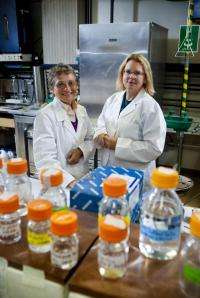
At the forefront of the war on cancer are Binghamton University researchers, Susannah Gal and Susan Bane, who are deploying a new tool in their study of an enzyme called tubulin tyrosine ligase, or TTL. Credit: Jonathan Cohen

Many of the newest weapons in the war on cancer come in the form of personalized therapies that can target specific changes in an individual's tumor. By disrupting molecular processes in tumor cells, these drugs can keep the tumor from growing and spreading. At the forefront of this work are Binghamton University researchers, Susan Bane, and Susannah Gal, who are deploying a new tool in their study of an enzyme called tubulin tyrosine ligase, or TTL.

In developing these targeted therapies, scientists need to understand exactly what kind of activities within a tumor cell these drugs disturb. Bane, a professor of organic and biological chemistry, and Gal, an associate professor of biological sciences, are getting an insider's look at these cells and paying particular interest to the many cancer cells that contain less-than-normal levels of TTL.

Funded by the National Institute of General Medical Sciences, Bane and Gal's work focuses on microtubules, which are structures that provide part of the scaffolding that gives a cell its structure and also help chromosomes line up correctly during cell division.

These microtubules are made of proteins called tubulin and during the course of a cell's life, an enzyme called carboxypeptidase clips an amino acid called tyrosine off the end of some of these proteins. Later, TTL puts tyrosine back on the tubulin. No one knows the purpose of this cycle, but as Bane points out, "We do know that if you don't have that enzyme, you'll die."

In certain cancer cells, the cycle of removing and reattaching tyrosine has fallen out of balance: Too many tubulins lack tyrosine.

"Patients who have that characteristic in their tumor have a poor prognosis," Bane says. "And those tumors tend to grow more aggressively."

Hoping to learn more about the role of TTL in cancer, Bane and Gal are studying the removal and reattachment of in live cells.

Bane has developed a way to mark tubulin with a fluorescent molecule using TTL, allowing the researchers to observe tubulin in action under a fluorescent microscope. The new labeling technique, using a small molecule, provides an easier way to watch the behavior of as cells divide. are often undergoing cell division at a much faster rate than normal cells, making the process a major target of cancer research.

Although Bane and Gal aren't trying to develop a new cancer treatment, their efforts to learn the role of TTL in tumor growth could someday make it easier to choose a treatment for a specific case of the disease.

"Potentially, someone could send us their tumor sample, and we could put it in our labeling system and say, 'Yes, that has a problem with the TTL system, and therefore you should be more aggressive with it,'" Gal says. "Or we could say, 'That's probably OK, so you can treat it with normal chemotherapy.'"

Bane and Gal are very hopeful that this new approach will then allow clinicians to treat cancer far more effectively as therapies would be personalized to an individual's tumor.

Explore further: Researchers find possible 'master switch' in deadly brain cancer

Provided by Binghamton University

not rated yet
add to favorites email to friend print save as pdf

Related Stories

Targeting tumors the natural way

Mar 25, 2007

By mimicking Nature's way of distinguishing one type of cell from another, University of Wisconsin-Madison scientists now report they can more effectively seek out and kill cancer cells while sparing healthy ones.

Researchers shed light on how tumor cells form

Jun 21, 2006

MIT cancer researchers have discovered a process that may explain how some tumor cells form, a discovery that could one day lead to new therapies that prevent defective cells from growing and spreading.

Cancers' sweet tooth may be weakness

Nov 18, 2009

The pedal-to-the-metal signals driving the growth of several types of cancer cells lead to a common switch governing the use of glucose, researchers at Winship Cancer Institute of Emory University have discovered.

Cell recycling protects tumor cells from anti-cancer therapy

Mar 06, 2008

Cells have their own recycling system: Discarded cellular components, from individual proteins through to whole cellular organs, are degraded and the building blocks re-used in a different place. The scientific term for this ...

Cancer cells more likely to genetically mutate

Feb 19, 2007

When cells become cancerous, they also become 100 times more likely to genetically mutate than regular cells, researchers have found. The findings may explain why cells in a tumor have so many genetic mutations, but could ...

Recommended for you

User comments : 0

More news stories

US teen birth rate drops to record low

US teen births have dropped to a record low, but the country still has one of the highest rates among developed nations, the US Centers for Disease Control and Prevention said Thursday.

Brain can be trained in compassion, study shows

Until now, little was scientifically known about the human potential to cultivate compassion—the emotional state of caring for people who are suffering in a way that motivates altruistic behavior.

Unlocking secrets of cell reproduction

Research published in Open Biology today identifies, for the first time, nearly all the genes required for reproduction of a cell in a living organism.

Very Large Telescope celebrates 15 years of success

(Phys.org) —With this new view of a spectacular stellar nursery ESO is celebrating 15 years of the Very Large Telescope—the world's most advanced optical instrument. This picture reveals thick clumps ...

US House sends message on Keystone pipeline

US lawmakers agreed to a bill that would speed construction of a Canada-US oil pipeline and circumvent the need for President Barack Obama's approval for the $5 billion project.

Be prepared for weather extremes

Unsettled weather is an Iowa mainstay, and so is Inside's annual reminder of the university's severe weather safety and preparedness guidelines—for storms, extreme heat, flooding and more.