How sweet it is: Why your taste cells love sugar so much
March 7, 2011

How sweet it is: Why your taste cells love sugar so much

Enlarge

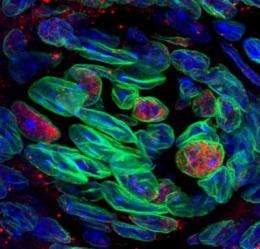
Some of the green cell nuclei in this taste bud contain the KATP sugar sensor, indicated in red. One of several sugar sensors recently shown by Monell scientists to be present in sweet-sensing taste cells, KATP may help regulate sensitivity to sweet taste under different nutritional conditions. Credit: Karen Yee, Monell Center

A new research study dramatically increases knowledge of how taste cells detect sugars, a key step in developing strategies to limit overconsumption. Scientists from the Monell Center and collaborators have discovered that taste cells have several additional sugar detectors other than the previously known sweet receptor.

"Detecting the sweetness of nutritive sugars is one of the most important tasks of our taste cells," said senior author Robert F. Margolskee, M.D., Ph.D., a molecular neurobiologist at Monell. "Many of us eat too much sugar and to help limit overconsumption, we need to better understand how a cell 'knows' something is sweet."

Scientists have known for some time that the T1r2+T1r3 receptor is the primary mechanism that allows taste cells to detect many sweet compounds, including sugars such as and sucrose and also , including saccharin and aspartame.

However, some aspects of sweet taste could not be explained by the T1r2+T1r3 receptor. For example, although the receptor contains two subunits that must join together for it to work properly, Margolskee's team had previously found that mice engineered to be missing the T1r3 subunit were still able to taste glucose and other sugars normally.

Knowing that sugar sensors in the are important to how dietary sugars are detected and absorbed, and that metabolic sensors in the pancreas are key to regulating blood levels of glucose, the Monell scientists used advanced molecular and cellular techniques to see if these same sensors are also found in taste cells.

The results, published in the , indicate that several sugar sensors from intestine and pancreas also are present in exactly those same sweet-sensing taste cells that have the T1r2+T1r3 sweet receptor.

"The taste system continues to amaze me at how smart it is and how it serves to integrate taste sensation with digestive processes," said Margolskee.

The different sugar taste sensors may have varied roles. An intestinal glucose sensor also found to be located in the sweet-sensitive taste cells may provide an explanation for another mystery of sweet taste: why just a pinch of table salt tastes sweet or salt added to baked goods enhances sweet taste. Known as SGLT1, this sensor is a transporter that moves glucose into the sweet taste cell when sodium is present, thus triggering the cell to register sweetness.

In pancreas, the sugar sensor known as the KATP channel, monitors glucose levels and triggers insulin release when they rise. The authors speculate that KATP may function in sweet taste cells to modulate taste cell sensitivity to sugars according to metabolic needs. For example, this sensor may respond to hormonal signals from the gut or to make taste cells less responsive to sweets after we have just eaten a sugary piece of pecan pie and do not need additional energy.

"Sweet taste cells have turned out to be quite complex. The presence of the KATP channel suggests that taste cells may play a role in regulating our sensitivity to sweet taste under different nutritional conditions," said first author Karen K. Yee, Ph.D., a cellular physiologist at Monell. "This knowledge may someday help us understand how to limit overconsumption of sweet foods."

Future studies will focus on understanding the complex connections between taste cells and the digestive and endocrine systems.

Provided by Monell Chemical Senses Center search and more info website


Rank 5 /5 (1 vote)
Relevant PhysicsForums posts
  • Potential Breakthrough in Seizure Control
    created22 hours ago
  • Popping/Cracked sternum.
    createdMay 25, 2012
  • Which Mental Illness Encompasses This Problem?
    createdMay 25, 2012
  • A question about drug tolerance
    createdMay 23, 2012
  • Poor nutrition leading to overeating?
    createdMay 23, 2012
  • Math and dyslexia?
    createdMay 21, 2012
  • More from Physics Forums - Medical Sciences

More news stories

Keep food safety in mind this memorial day weekend

(HealthDay) -- Picnics, parades and cookouts are as much a part of Memorial Day weekend as tributes to the United States' war veterans.

Medicine & Health / Health

created 8 hours ago | popularity not rated yet | comments 0

Family history of Alzheimer's affects functional connectivity

(HealthDay) -- Cognitively normal individuals with a family history of late-onset Alzheimer's disease (AD) may display lower resting state functional connectivity in the default mode network (DMN) of the brain, ...

Medicine & Health / Alzheimer's disease & dementia

created 17 hours ago | popularity not rated yet | comments 0

Transvaginal mesh op restores pelvic organ prolapse at price

(HealthDay) -- Transvaginal mesh (TVM) procedures are effective for anatomical restoration of pelvic organ prolapse (POP), but patients report a worsening of sexual function following surgery, according to ...

Medicine & Health / Other

created 18 hours ago | popularity not rated yet | comments 0

Travel to high altitudes tied to Crohn's, colitis flare-ups

(HealthDay) -- People with inflammatory bowel disease, which includes Crohn's disease and colitis, may be at increased risk for flare-ups when they fly or travel to high altitudes for skiing or mountain climbing, ...

Medicine & Health / Inflammatory disorders

created 18 hours ago | popularity not rated yet | comments 1 | with audio podcast

Weight struggles? Blame new neurons in your hypothalamus

New nerve cells formed in a select part of the brain could hold considerable sway over how much you eat and consequently weigh, new animal research by Johns Hopkins scientists suggests in a study published in the May issue ...

Medicine & Health / Neuroscience

created May 21, 2012 | popularity 5 / 5 (1) | comments 6 | with audio podcast


Scientist: Evolution debate will soon be history

(AP) -- Richard Leakey predicts skepticism over evolution will soon be history. Not that the avowed atheist has any doubts himself.

Dell tablet leak: 10.1-inch display, two-battery choice

(Phys.org) -- Headline after headline talks about vendors’ tablets in the wings as likely number-one contenders for the iPad. Such claims have justifiably been taken with a grain of salt, considering ...

SpotterRF debuts Radar Backpack Kit (w/ Video)

(Phys.org) -- SpotterRF has announced a special radar backpack kit designed to enhance situational awareness for soldiers on the ground. The company says its special radar is designed for warfighters as part ...

SpaceX capsule has 'new car' smell, astronauts say (Update)

SpaceX's Dragon cargo vessel smells like a new car, said astronauts at the International Space Station after opening the hatches Saturday following the spacecraft's landmark mission to the orbiting lab.

Thousands of shellfish found dead in Peru

Thousands of crustaceans were found dead off the coast of Lima following the mystery mass death of dolphins and pelicans, the Peruvian Navy said Friday.

Astronomers seize last chance in lifetime for Venus Transit

Astronomers are gearing for one the rarest events in the Solar System: an alignment of Earth, Venus and the Sun that will not be seen for another 105 years.