Super sense of smell not innate
March 9, 2011 by Marlowe Hood
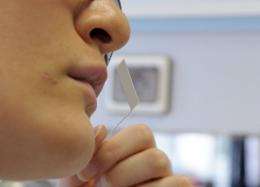
A man smells a perfume in a laboratory in France in 2010. World-class "noses" in the perfume and wine business are not born with an outsized sense of smell but acquire it through years of professional sniffing, according to new research.
World-class "noses" in the perfume and wine business are not born with an outsized sense of smell but acquire it through years of professional sniffing, according to new research.
In experiments with novice and veteran perfume makers, French scientists found that the ability to detect and identify hundreds, even thousands, of different odours depends almost entirely on rigorous training.
"To be a 'nose' you have to practise, just as a pianist plays his scales," said Jean-Pierre Royet, a neuroscientist at the Universite Claude Bernard in Lyon, France, and the main architect of a study published this week in the journal Human Brain Mapping.
Over time, the study also showed, activity in the brain shifts from the area that governs conscious effort to a region in which actions are performed automatically, like breathing or swallowing.
This makes it possible to graduate from technical competence to artistry, the researchers argue.
In the same way that musicians can be more creative once they no longer need to concentrate on technical virtuosity, great perfumers can conjure new scents just by imagining -- and mentally mixing -- the smell of individual ingredients.
Previous research had shown that constant training changes the brain activity of musicians and athletes, but no one had investigated whether the same would hold for olfaction, the ability to detect odours.
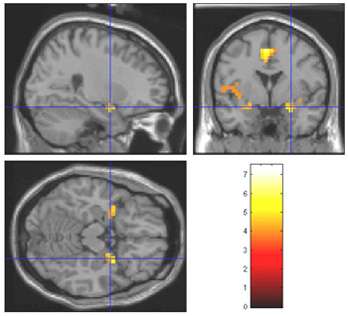
The primary olfactory cortex is activated in both hemispheres when the subjects mentally imagine odors. The activations are represented in horizontal and frontal sagittal sections of the brain. © JP Royet
To find out, Royet and colleagues enlisted 28 volunteers, half of them student perfumers, and the other half scent makers with five to 35 years in the business.The researchers scanned the brains of both groups during two kinds of tests. In one, the subjects were asked to identify dozens of odours selected from a standard palate of 300 chemicals.
In the other, they had to imagine the smells after looking at their chemical names.
Both groups scored well in the two tests though, not surprisingly, the old pros were more accurate and faster, especially when it came to retrieving the smells by memory.
What surprised the researchers is that different parts of the brain lit up.
For novices, activity was more concentrated in a region, called the frontal cortex, responsible for conscious perception.
For the veteran sniffers, neurons fired more vigorously in the parahippocampal gyrus, an area involved in memory recall and mental imagery.
"Our findings demonstrate the extraordinary ability of the brain to adapt to environmental demands and reorganise with experience," Royet said by phone.
They also show that "mental imaging of odours develops from daily practice and is not an innate skill," he added.
Not all experts agree that odour detection is purely a matter of learning.
Patrick Mac Leod, former head of the Laboratory for Sensorial Neurobiology, near Versailles, says that olfactory thresholds vary dramatically.
"No two people will ever smell the same thing in the same way," he noted. "When we perceive an odour the exact nature of the sensation that is produced depends as much on the observer as the object."
In experiments, he has shown that a small quantity of a given molecule may be imperceptible for one person and easily detected by another. For a different chemical, it may be the reverse.
These thresholds can easily vary from one person to the next by a factor of a thousand.
Mac Leod also points out that the human genome contains nearly 350 olfactory genes -- far more than for vision or hearing -- resulting in highly individualised odour detection.
"You are never going to transform someone who is insensitive to a certain molecule into someone who smells it well," he said.
But even these variations in perception and genes, he acknowledged, do not change the core finding that practice makes perfect when it comes, say, to sniffing out the difference between a tanky or toasty wine.
"It's a little like a policeman who combs through dozens of clues to find the truth. With training, the nose becomes a keen investigator of anything related to odours."
(c) 2011 AFP
-
From lemons to lemonade: Reaction uses carbon dioxide to make carbon-based semiconductor,
32 comments
-
Thioridazine kills cancer stem cells in human while avoiding toxic side-effects of conventional cancer treatments,
3 comments
-
SpaceX private rocket blasts off for space station (Update),
42 comments
-
Climate scientists say they have solved riddle of rising sea,
30 comments
-
Research team claims to have found evidence Lake Cheko is impact crater for Tunguska Event,
18 comments
-
Potential Breakthrough in Seizure Control
23 hours ago
-
Popping/Cracked sternum.
May 25, 2012
-
Which Mental Illness Encompasses This Problem?
May 25, 2012
-
A question about drug tolerance
May 23, 2012
-
Poor nutrition leading to overeating?
May 23, 2012
-
Math and dyslexia?
May 21, 2012
- More from Physics Forums - Medical Sciences
More news stories
Keep food safety in mind this memorial day weekend
(HealthDay) -- Picnics, parades and cookouts are as much a part of Memorial Day weekend as tributes to the United States' war veterans.
8 hours ago |
not rated yet |
0
Family history of Alzheimer's affects functional connectivity
(HealthDay) -- Cognitively normal individuals with a family history of late-onset Alzheimer's disease (AD) may display lower resting state functional connectivity in the default mode network (DMN) of the brain, ...
Medicine & Health / Alzheimer's disease & dementia
17 hours ago |
not rated yet |
0
Transvaginal mesh op restores pelvic organ prolapse at price
(HealthDay) -- Transvaginal mesh (TVM) procedures are effective for anatomical restoration of pelvic organ prolapse (POP), but patients report a worsening of sexual function following surgery, according to ...
18 hours ago |
not rated yet |
0
Travel to high altitudes tied to Crohn's, colitis flare-ups
(HealthDay) -- People with inflammatory bowel disease, which includes Crohn's disease and colitis, may be at increased risk for flare-ups when they fly or travel to high altitudes for skiing or mountain climbing, ...
Medicine & Health / Inflammatory disorders
18 hours ago |
not rated yet |
1
|
Weight struggles? Blame new neurons in your hypothalamus
New nerve cells formed in a select part of the brain could hold considerable sway over how much you eat and consequently weigh, new animal research by Johns Hopkins scientists suggests in a study published in the May issue ...
Medicine & Health / Neuroscience
May 21, 2012 |
5 / 5 (1) |
6
|
Scientist: Evolution debate will soon be history
(AP) -- Richard Leakey predicts skepticism over evolution will soon be history. Not that the avowed atheist has any doubts himself.
Dell tablet leak: 10.1-inch display, two-battery choice
(Phys.org) -- Headline after headline talks about vendors tablets in the wings as likely number-one contenders for the iPad. Such claims have justifiably been taken with a grain of salt, considering ...
SpotterRF debuts Radar Backpack Kit (w/ Video)
(Phys.org) -- SpotterRF has announced a special radar backpack kit designed to enhance situational awareness for soldiers on the ground. The company says its special radar is designed for warfighters as part ...
SpaceX capsule has 'new car' smell, astronauts say (Update)
SpaceX's Dragon cargo vessel smells like a new car, said astronauts at the International Space Station after opening the hatches Saturday following the spacecraft's landmark mission to the orbiting lab.
Thousands of shellfish found dead in Peru
Thousands of crustaceans were found dead off the coast of Lima following the mystery mass death of dolphins and pelicans, the Peruvian Navy said Friday.
Astronomers seize last chance in lifetime for Venus Transit
Astronomers are gearing for one the rarest events in the Solar System: an alignment of Earth, Venus and the Sun that will not be seen for another 105 years.