New stretchable electronics device promises to make cardiac ablation therapy simpler
In an improvement over open-heart surgery, cardiologists now use catheters to eliminate damaged heart tissue in certain patients, such as those with arrhythmias. But this, too, can be a long and painful procedure as many catheters, with different functions, need to be inserted sequentially.
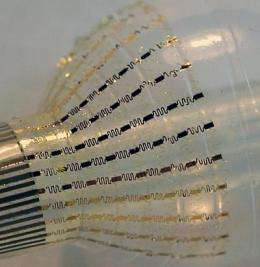
Now an interdisciplinary team including researchers from Northwestern University has developed one catheter that can do it all. This tool for cardiac ablation therapy has all necessary medical devices printed on a standard balloon catheter: a device for eliminating damaged tissue using heat, temperature and pressure sensors, an LED and an electrocardiogram (EKG) sensor.
The multifunctional catheter makes a minimally invasive technique for heart surgery even better. Both diagnostic and treatment capabilities are combined in one. The stretchable electronics developed by Yonggang Huang of Northwestern and John Rogers of the University of Illinois at Urbana-Champaign make it possible.
The research will be published March 6 by the journal Nature Materials.
"The use of one catheter to achieve all these functions will significantly improve clinical arrhythmia therapy by reducing the number of steps in the procedure, thereby saving time and reducing costs," said Huang, Joseph Cummings Professor of Civil and Environmental Engineering and Mechanical Engineering at Northwestern's McCormick School of Engineering and Applied Science. He led the Northwestern portion of the work.
In conversation with collaborating cardiologists, Moussa Mansour, M.D., of Harvard Medical School; Marvin Slepian, M.D., of the University of Arizona; and Joshua Moss, M.D., and Brian Litt, M.D., of the University of Pennsylvania, Huang and Rogers recognized that their stretchable electronics could improve the surgical tools currently used in cardiac ablation therapy. This procedure is used to cure or control a variety of arrhythmias, or irregular heartbeats.
The electronics Huang and Rogers use in this study are based on a "pop-out" design of interconnects, similar to their early design for stretchable electronics but with much larger -- approximately 130 percent -- stretchability. The type of arrhythmia the team focuses on is tachycardia, when the heart beats too fast; the tissue that induces this condition is the target of their ablation therapy.
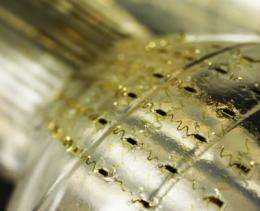
This ability of the electronics to stretch is important because the researchers print all the necessary medical devices on a section of a standard endocardial balloon catheter (a thin, flexible tube) where the wall is thinner than the rest. (This section is slightly recessed from the rest of the catheter's surface.) There the sensitive devices and actuators are protected during the catheter's trip through the body to the heart. Once the catheter reaches the heart, the catheter is inflated, and the thin section expands significantly; the electronics are now exposed and in contact with the heart.
"Our challenge was how to make the electronics sustain such a large stretch when the thin wall expands under pressure," Huang said. "We devised what we call a 'pop-out interconnect' that performs very well. We didn't expect the electronics to sustain a stretch nearly three times the section's length."
Once the catheter is in place, the individual devices can perform their specific tasks when needed. The pressure sensor determines the pressure on the heart; the EKG sensor monitors the heart's condition during the procedure; the LED sheds light for imaging and also provides the energy for ablation therapy to eliminate (ablate) the tachycardia-inducing tissue; and the temperature sensor controls the temperature so as not to damage other, good tissue.
The entire system is designed to operate reliably without any changes in properties as the balloon inflates and deflates. "It demands all the features and capabilities that we've developed in stretchable electronics over the years in a pretty aggressive way," Rogers said. "It also really exercises the technology in an extreme, and useful, manner -- we put everything on the soft surface of a rubber balloon and blow it up without any of the devices failing."
These devices can deliver critical high-quality information, such as temperature, mechanical force, blood flow and electrogram, to the surgeon in real time. While the multifunctional catheter has not been used with humans, the researchers have demonstrated the utility of the device with anesthetized animals.
The fabrication techniques the engineers used in developing the balloon device could be exploited for integrating many classes of advanced semiconductor devices on a variety of surgical instruments. For example, the team also demonstrated surgical gloves with sensor arrays mounted on the fingertips to show that the electronics could be applied to other biomedical platforms.
Huang led the theory and mechanical and thermal design work at Northwestern. He and his colleagues' contribution was to ensure the mechanical integrity of the device so there was no failure during significant stretching and to control temperature during cardiac ablation therapy. Rogers, the Lee J. Flory Founder Chair in Engineering and professor of materials science and engineering at the University of Illinois at Urbana-Champaign, led the design, experimental and fabrication work.
More information: The paper is titled "Materials for Multifunctional Balloon Catheters with Capabilities in Cardiac Electrophysiological Mapping and Ablation Therapy."
mc10, a startup commercializing the catheter technology, was a driving force in the study and development of the catheter with 4 co-authors on the Nature paper.


