NeuroImage: Multiplexing in the visual brain
March 24, 2011

NeuroImage: Multiplexing in the visual brain

Enlarge

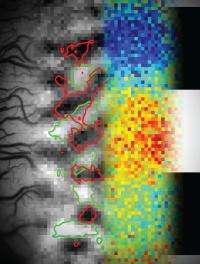
Visualization of how the primary visual cortex encodes both orientation and retinotopic motion of a visual object simultaneously. As a visual stimulus the scientists used a horizontal grating moving downwards on a monitor screen (sketched at most right). From left to right: The brain’s vascular surface and a 20 millisecond camera snapshot of brain activity. Dark regions represent domains in which nerve cells are active which encode the horizontal grating orientation (see pattern of red outlines). At the same time, overlaid on this patchy map, a traveling activity wave was observed moving downwards across the brain (red represents peak activity, blue depicts low amplitude). The wave thus represented the actual movement of the grating stripes independently from the orientation encoding pattern. Credit: Jancke/RUB

Imagine sitting in a train at the railway station looking outside: Without analyzing the relative motion of object contours across many different locations at the same time, it is often difficult to decide whether it's your train that starts moving, or the one at the opposite track. How are these diverse information conveyed simultaneously through the network of millions of activated nerve cells in the visual brain?

"Neurons synchronize with different partners at different frequencies" says Dr. Dirk Jancke, Neuroscientist at the Ruhr-University in Bochum, Germany. A new imaging technique enabled to show that such functioning results in distinct activity patterns overlaid in . These patterns individually signal motion direction, speed, and orientation of object contours within the same network at the same time. Together with colleagues at the University of Osnabrück, the Bochum scientists successfully visualized such multiplexing using a modern real-time optical imaging method that exploits a specific voltage-sensitive dye.

The dye incorporates in the brain cells' membrane and changes fluorescence whenever these receive or send electrical signals. Hence, high resolution camera systems allow to simultaneously capture activities of millions of nerve cells across several square millimeters across the brain.

As a stimulus the researchers used simple oriented gratings with alternating black-white stripes drifting at constant speed across a monitor screen. These stimuli have been used for more than 50 years in visual neuroscience and still are conventionally applied in medical diagnostics. However, brain activity that signals both the grating's orientation and its motion simultaneously has not been detected so far. Such signals could now be demonstrated for the first time. Note that further computational steps including sophisticated analysis were needed before those smallest brain activity signals became visible.

Optical imaging became state-of-the-art since it allows fine grained resolution of cortical pattern activity, so-called maps, in which local groups of active nerve cells represent grating orientation. Thereby, a particular grating orientation activates different groups of resulting in unique patchy patterns. Their specific map layout encodes actual stimulus orientation.

Jancke: "Our novel imaging method furthermore captures propagating activity waves across these orientation maps. Hence, we additionally observe gratings moving in real-time across the brain. In this way, motion direction and speed can be estimated independently from orientation maps, which enables resolving ambiguities occurring in visual scenes of everyday life." The emerging spatial-temporal patterns could then individually be received and interpreted by other brain areas. To give a picture: a radio gets a permanent stream of broadcasts simultaneously. In order to listen to a particular station one has to choose only the channel to tune. For example, a following brain area might preferentially compute an object's orientation while others process its movement direction or speed simultaneously. In the future, the scientists hope to discover more of the brains real-time action when similar tools are used with increasing stimulus complexity: Naturalistic images are experienced so effortlessly in everyday life. Still it remains an intriguing question how the brain handles such complex data gaining a stable percept every moment in time.

More information: Onat S, Nortmann N, Rekauzke S, König P, Jancke D (2011). Independent encoding of grating motion across stationary feature maps in primary visual cortex visualized with voltage-sensitive dye imaging. Neuroimage 55: 1763-1770. http://dx.doi.org/ … .2011.01.004

Provided by Ruhr-University Bochum

4.5 /5 (2 votes)  

Rank 4.5 /5 (2 votes)
Relevant PhysicsForums posts
  • Potential Breakthrough in Seizure Control
    created20 hours ago
  • Popping/Cracked sternum.
    createdMay 25, 2012
  • Which Mental Illness Encompasses This Problem?
    createdMay 25, 2012
  • A question about drug tolerance
    createdMay 23, 2012
  • Poor nutrition leading to overeating?
    createdMay 23, 2012
  • Math and dyslexia?
    createdMay 21, 2012
  • More from Physics Forums - Medical Sciences

More news stories

Keep food safety in mind this memorial day weekend

(HealthDay) -- Picnics, parades and cookouts are as much a part of Memorial Day weekend as tributes to the United States' war veterans.

Medicine & Health / Health

created 6 hours ago | popularity not rated yet | comments 0

Family history of Alzheimer's affects functional connectivity

(HealthDay) -- Cognitively normal individuals with a family history of late-onset Alzheimer's disease (AD) may display lower resting state functional connectivity in the default mode network (DMN) of the brain, ...

Medicine & Health / Alzheimer's disease & dementia

created 15 hours ago | popularity not rated yet | comments 0

Transvaginal mesh op restores pelvic organ prolapse at price

(HealthDay) -- Transvaginal mesh (TVM) procedures are effective for anatomical restoration of pelvic organ prolapse (POP), but patients report a worsening of sexual function following surgery, according to ...

Medicine & Health / Other

created 15 hours ago | popularity not rated yet | comments 0

Travel to high altitudes tied to Crohn's, colitis flare-ups

(HealthDay) -- People with inflammatory bowel disease, which includes Crohn's disease and colitis, may be at increased risk for flare-ups when they fly or travel to high altitudes for skiing or mountain climbing, ...

Medicine & Health / Inflammatory disorders

created 16 hours ago | popularity not rated yet | comments 1 | with audio podcast

Of mice and mental models: Neuroscientific implications of risk-optimized behavior in the mouse

(Medical Xpress) -- Regardless of an organism’s biological complexity, every encephalized animal continuously makes under-informed behavioral choices that can have serious consequences. Despite its ubiquity, ...

Medicine & Health / Neuroscience

created May 25, 2012 | popularity not rated yet | comments 0 | with audio podcast feature


Dell tablet leak: 10.1-inch display, two-battery choice

(Phys.org) -- Headline after headline talks about vendors’ tablets in the wings as likely number-one contenders for the iPad. Such claims have justifiably been taken with a grain of salt, considering ...

Scientist: Evolution debate will soon be history

(AP) -- Richard Leakey predicts skepticism over evolution will soon be history. Not that the avowed atheist has any doubts himself.

SpotterRF debuts Radar Backpack Kit (w/ Video)

(Phys.org) -- SpotterRF has announced a special radar backpack kit designed to enhance situational awareness for soldiers on the ground. The company says its special radar is designed for warfighters as part ...

SpaceX capsule has 'new car' smell, astronauts say (Update)

SpaceX's Dragon cargo vessel smells like a new car, said astronauts at the International Space Station after opening the hatches Saturday following the spacecraft's landmark mission to the orbiting lab.

Thousands of shellfish found dead in Peru

Thousands of crustaceans were found dead off the coast of Lima following the mystery mass death of dolphins and pelicans, the Peruvian Navy said Friday.

Astronomers seize last chance in lifetime for Venus Transit

Astronomers are gearing for one the rarest events in the Solar System: an alignment of Earth, Venus and the Sun that will not be seen for another 105 years.