Motors on a mission

Mar 25, 2011 by By Laurie Moore
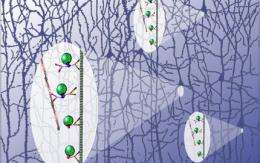
Inside each neuron, microtubules carry dendritic and axonal proteins to the dendrite and the axon with the help of motors Myosin Va and Myosin VI. Illustration by Su Hyun Kwon.

(PhysOrg.com) -- In a new study, Don Arnold and collaborators show that a microscopic motor drives axonal proteins to the right location in a neuron.

Within each of our bodies are billions of . These relay chemical and , forming vast networks that comprise the human .

Within each neuron is a microscopic network of its own, a complex system of signal transmissions. Proteins receive signals at the cell’s dendrite and transmit them at the axon at the other end, passing the impulses from one neuron to another and allowing human beings to think, perceive and move.

“Dendrites and axons look different and have different functions so it makes sense that these two areas would be comprised of different proteins,” said Don Arnold, associate professor of biological sciences in the College. “My lab studies how proteins made in the cell body get transported specifically to dendrites or axons.”

Proteins are synthesized within the neuron and carried in a bubble called a vesicle down highways of microtubules that point to the dendrite and the axon. Neither the two proteins themselves nor the microtubules know where the proteins should end up, so a mix of dendritic and axonal proteins will go both ways, to the dendrite and to the axon.
Arnold admitted that the system is counterintuitive, if not downright complicated. “You’d think the proteins would be put on the right microtubules to start with.”
But the proteins are not always put on the correct path. Some proteins will end up in the right place, while others must be redirected.

A 2009 study by Arnold and his collaborators published online in Nature Neuroscience solved one half of what happens if proteins end up in the wrong place. If the proteins first encounter a microtubule heading toward the axon, both types will be carried toward the axon. However, the team discovered that a motor called Myosin Va acts as a filter in the axon. Myosin Va binds to the dendritic proteins, carries them out of the axon and allows the axonal proteins to continue.

The second paper, published on March 1 in PLoS Biology and authored by graduate student Tommy Lewis Jr. of the College, Tianyi Mao of the Howard Hughes Medical Institute, and Arnold, explores how the axonal proteins end up in the axon.

“Axonal proteins have a more complicated way of targeting to the axon,” Arnold said. “There are two ways of getting to an axon. The proteins either go directly to the axon or, more bizarrely, they go to the dendrites where they’re put on the surface of the cell.”

Arnold and his team discovered that a related motor protein, Myosin VI, retrieves wayward axonal proteins from the dendrite, plucking the axonal proteins off the cellular membrane and carrying them to the axon. Myosin VI, they found, also plays a role in helping the axonal proteins find the axon in the first place.
“This whole process can be explained by the interaction with Myosin VI. It does both things,” Arnold said.

Understanding this microscopic series of events will allow for more effective targeting of axons or dendrites, enabling finer control over neurons for basic research and possibly the clinical treatment of neurological disorders.

“It’s extremely useful to be able to send something to an axon or a dendrite in an efficient manner,” Arnold said. “What I like about this is that it’s a simple system where you can do experiments that give you a definite answer. It’s a way of moving forward.”

Explore further: Brain uses internal 'average voice' prototype to identify who is talking

Related Stories

Autopilot guides proteins in brain

Apr 21, 2009

Proteins go everywhere in the cell and do all sorts of work, but a fundamental question has eluded biologists: How do the proteins know where to go?

What makes an axon an axon?

Nov 10, 2008

Inside every axon is a dendrite waiting to get out. Hedstrom et al. converted mature axons into dendrites by banishing a protein crucial for neuron development. The results suggest that this transformation could occur after ...

Research could lead to new treatments for brain injuries

Nov 20, 2007

MIT researchers have identified a family of proteins key to the formation of the communication networks critical for normal brain function. Their research could lead to new treatments for brain injury and ...

Recommended for you

Depression common among children with temporal lobe epilepsy

1 hour ago

A new study determined that children and adolescents with seizures involving the temporal lobe are likely to have clinically significant behavioral problems and psychiatric illness, especially depression. Findings published ...

The secret lives, and deaths, of neurons

3 hours ago

As the human body fine-tunes its neurological wiring, nerve cells often must fix a faulty connection by amputating an axon—the "business end" of the neuron that sends electrical impulses to tissues or other ...

Breakthrough on Huntington's disease

3 hours ago

Researchers at Lund University have succeeded in preventing very early symptoms of Huntington's disease, depression and anxiety, by deactivating the mutated huntingtin protein in the brains of mice.

User comments : 3

Adjust slider to filter visible comments by rank

Display comments: newest first

ZephirAWT
1 / 5 (1) Mar 25, 2011
This way of intracellular transport is relatively common mechanism in most prokaryotic cells (you can consider the YT video in this connection http://www.youtub...kmc4Hw). It's apparent, inside of strongly elongated neural cells such mechanism must be very important, because there's no feasible way, how to distribute important chemicals along whole cell in necessary time.
FrankHerbert
0.7 / 5 (48) Mar 25, 2011
Molecular machinery.
tj10
not rated yet Mar 27, 2011
Within each neuron is a microscopic network of its own, a complex system of signal transmissions. Proteins receive signals at the cells dendrite and transmit them at the axon at the other end, passing the impulses from one neuron to another and allowing human beings to think, perceive and move.

The levels of complexity here are just astounding! Good job - really good science here! All this so that I can think, perceive, and move! How something like this can evolve through blind random purposeless processes, I sure don't know! And somehow, it is not surprising to me that no one else knows either.

More news stories

Scientists discover molecule triggers sensation of itch

Scientists at the National Institutes of Health report they have discovered in mouse studies that a small molecule released in the spinal cord triggers a process that is later experienced in the brain as the sensation of ...

A quantum simulator for magnetic materials

Physicists understand perfectly well why a fridge magnet sticks to certain metallic surfaces. But there are more exotic forms of magnetism whose properties remain unclear, despite decades of intense research. ...